
01Free Template · Excel and PDF
ERP RFP Template: Free Excel with Requirements, Scorecard & Vendor Questions
Free ERP RFP template in Excel, no sign-up: 78 requirements in 11 areas, vendor response codes, a weighted scorecard and 15 questions every vendor should answer.
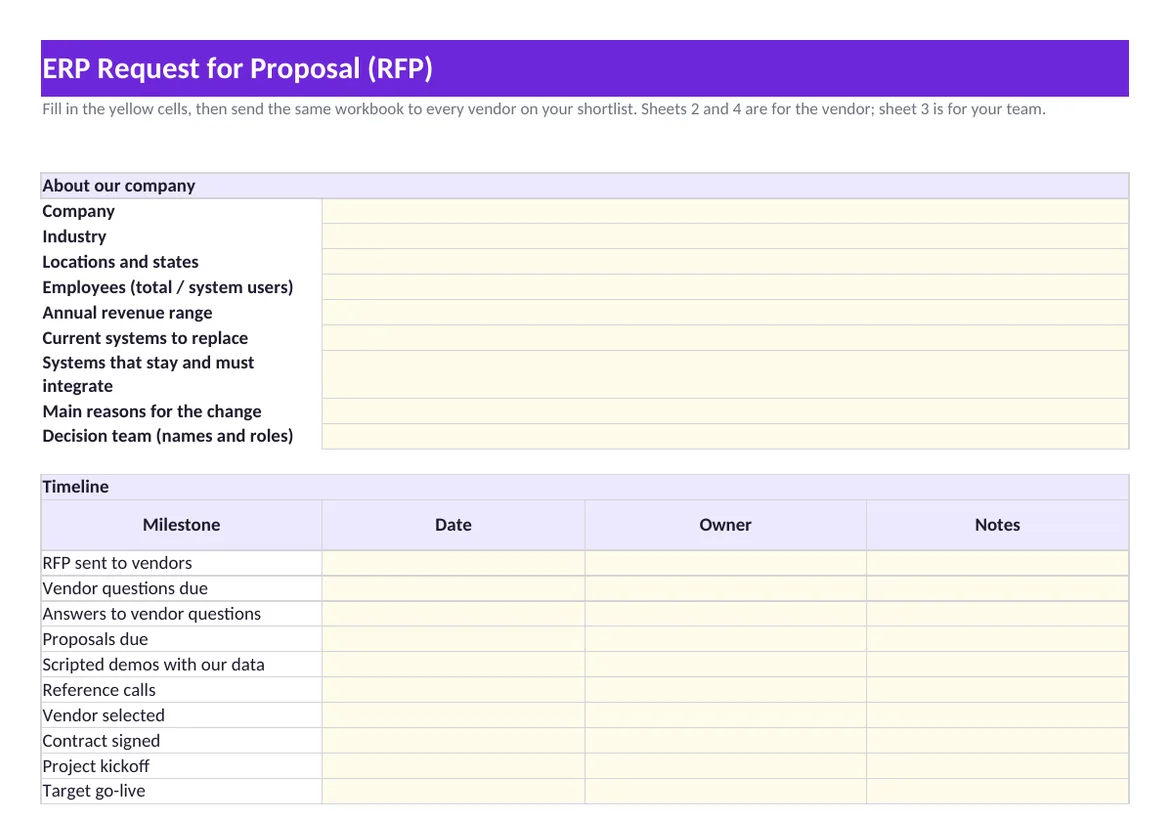
What Is in the Workbook
| Sheet | Who fills it in | What it does |
|---|---|---|
| 1 Overview | You | Describes your company, the systems to replace and the selection timeline from RFP to go-live |
| 2 Requirements | You set priorities, the vendor responds | 78 requirements across finance, sales, purchasing, inventory, manufacturing, service, HR and time, reporting, integrations, security and AI |
| 3 Scorecard | Your selection team | Scores three vendors on nine weighted criteria and totals them |
| 4 Vendor questions | The vendor | 15 questions on implementation, cost, support, data and AI, answered in writing |
Send every vendor the same file. Because each requirement gets one of five response codes, the answers come back comparable, and the summary under the requirements sheet counts how many of your must-haves need customization, a third-party product or are not available.
How to Run an ERP Selection with It
- 1. Write down how you work before what you want. Walk one order from first contact to payment and note every handoff, spreadsheet and retyped number. The requirements that matter come out of that walk, not out of a feature list.
- 2. Cut the list. Delete rows that do not apply and mark what remains as Must, Should or Nice. If everything is a must-have, nothing is.
- 3. Shortlist three to five vendors. More than that and nobody reads the answers properly.
- 4. Ask for a scripted demo. Give each vendor the same two or three scenarios from your own operations and your own sample data. A demo on the vendor's script shows the vendor's strengths; a demo on yours shows the fit.
- 5. Call references yourself. Ask what went wrong during implementation and how the vendor handled it.
- 6. Score as a team, then compare totals. A large gap between two people's scores is worth a conversation before the totals are.
Read the Response Codes, Not the Yes Count
| Response | What it means for you |
|---|---|
| Standard | Works out of the box. Ask to see it in the demo. |
| Configuration | Set up without programming. Ask who does it and whether it is in the implementation scope. |
| Customization | Needs development. Ask who maintains it and what happens to it when the system is upgraded. |
| Third party | Needs another product. Ask who supports the connection and what it adds to the recurring cost. |
| Not available | A gap. Decide whether you can change the process or whether this is a reason to drop the vendor. |
Customization is not bad in itself: every company does something its own way, and that is often where it earns its margin. What matters is who carries it afterwards. That question is the subject of our guide to custom vs. off-the-shelf ERP.
Put Draivix on the Shortlist
Draivix covers sales, finance, inventory, production, service and time & attendance in one system, assembled and configured around how your company works: see what each module does and how we tailor it. Send us your filled-in workbook and we will answer every row, including the ones where the honest answer is "not today": book a consultation.
02Frequently Asked Questions
What should an ERP RFP include?
A short description of your company and current systems, a prioritized list of requirements with a fixed way for vendors to respond, questions about implementation, cost, support and data, your selection timeline and how proposals will be scored.
How many requirements should an ERP RFP have?
Enough to describe how you work, few enough that vendors answer carefully. For a small or midsize company that is usually well under a hundred. The template starts with 78; delete what does not apply and add what is specific to you.
What is the difference between an RFI, an RFP and an RFQ?
A request for information (RFI) collects general facts to build a longlist. A request for proposal (RFP) asks shortlisted vendors how they would meet your requirements. A request for quotation (RFQ) asks for a price on a defined scope.
Do small companies need an ERP RFP?
A formal tender is not required, but writing down requirements and asking every vendor the same questions is worth it at any size. It keeps the decision about your operations instead of about the best demo.
03More Free Tools
Related Templates & Calculators
- Custom ERP vs. Off-the-Shelf ERP: How to ChooseCustom ERP or off-the-shelf? Compare fit, time to go-live, upgrades, risk and who carries the changes, and see where a configured, tailored system sits between them.Open
- No Tax on Overtime Calculator: W-2 Box 12 Code TTFree no tax on overtime calculator: find your qualified overtime (the half in time and a half), the $12,500 limit and what employers report in W-2 box 12, code TT.Open
- Quote Template: Free Price Quotation (Excel & PDF)Free quote template in Excel and PDF: line items, sales tax, delivery, validity date, scope and assumptions and a customer acceptance line. No sign-up.Open
- Exempt vs. Non-Exempt Employees: Overtime & Salary TestExempt vs. non-exempt explained: the $684 weekly salary level, the duties tests, higher California and New York thresholds, and what time records each group needs.Open
Let’s start together
Tell us how your business works.
We will show you what a system that takes over part of that work could look like.
Book a consultation