
01Free Online Calculator + Excel Workbook
Final Paycheck Laws by State: Deadlines After a Firing or a Resignation, Vacation Payout and Penalties
When final pay is due in all 50 states and DC after a firing, a layoff or a resignation, which states require vacation payout, and the late-pay penalties.
Final Paycheck Due Date Calculator
Read in each state's statute or labor department page on November 23, 2026. Hours are counted as whole days and business days skip weekends but not holidays, so where the statute also excludes holidays the legal deadline can be a day later than shown; a labor agreement, a written contract or a local law can change the date.
Federal law sets no deadline for a final paycheck: the U.S. Department of Labor says employers are not required to pay former employees immediately, but some states are. The state deadline depends on how the job ended. After a firing, California, Colorado, Massachusetts, Missouri and Nevada want the wages on the day of discharge; Texas allows 6 calendar days and Alaska 3 working days. After a resignation, most states allow the next regular payday, while California allows 72 hours and pays on the last day an employee who gave 72 hours' notice.
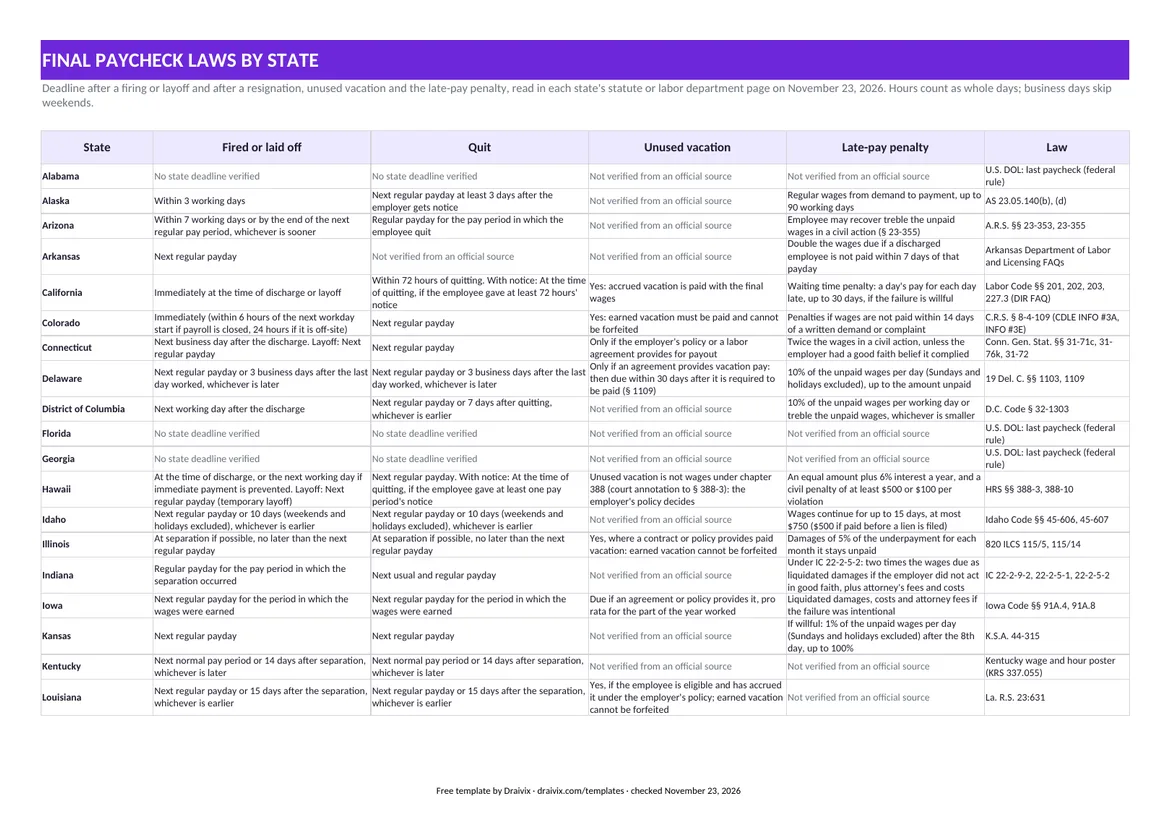
The calculator above takes the state, how the job ended, the last day worked and your next regular payday, and returns the date the final paycheck is due with the rule and the law behind it. The table below gives every state and DC with the deadline after a firing and after a resignation, the unused vacation rule and the penalty for paying late. Each row was read in the state's statute or labor department page on November 23, 2026; where we could not read an official source, the row says so instead of guessing.
Final Paycheck Laws by State
| State | Fired or laid off | Quit | Unused vacation | Late-pay penalty | Law |
|---|---|---|---|---|---|
| Alabama | No state deadline verified | No state deadline verified | Not verified from an official source | Not verified from an official source | U.S. DOL: last paycheck (federal rule) |
| Alaska | Within 3 working days | Next regular payday at least 3 days after the employer gets notice | Not verified from an official source | Regular wages from demand to payment, up to 90 working days | AS 23.05.140(b), (d) |
| Arizona | Within 7 working days or by the end of the next regular pay period, whichever is sooner | Regular payday for the pay period in which the employee quit | Not verified from an official source | Employee may recover treble the unpaid wages in a civil action (§ 23-355) | A.R.S. §§ 23-353, 23-355 |
| Arkansas | Next regular payday | Not verified from an official source | Not verified from an official source | Double the wages due if a discharged employee is not paid within 7 days of that payday | Arkansas Department of Labor and Licensing FAQs |
| California | Immediately at the time of discharge or layoff | Within 72 hours of quitting. With notice: At the time of quitting, if the employee gave at least 72 hours' notice | Yes: accrued vacation is paid with the final wages | Waiting time penalty: a day's pay for each day late, up to 30 days, if the failure is willful | Labor Code §§ 201, 202, 203, 227.3 (DIR FAQ) |
| Colorado | Immediately (within 6 hours of the next workday start if payroll is closed, 24 hours if it is off-site) | Next regular payday | Yes: earned vacation must be paid and cannot be forfeited | Penalties if wages are not paid within 14 days of a written demand or complaint | C.R.S. § 8-4-109 (CDLE INFO #3A, INFO #3E) |
| Connecticut | Next business day after the discharge. Layoff: Next regular payday | Next regular payday | Only if the employer's policy or a labor agreement provides for payout | Twice the wages in a civil action, unless the employer had a good faith belief it complied | Conn. Gen. Stat. §§ 31-71c, 31-76k, 31-72 |
| Delaware | Next regular payday or 3 business days after the last day worked, whichever is later | Next regular payday or 3 business days after the last day worked, whichever is later | Only if an agreement provides vacation pay: then due within 30 days after it is required to be paid (§ 1109) | 10% of the unpaid wages per day (Sundays and holidays excluded), up to the amount unpaid | 19 Del. C. §§ 1103, 1109 |
| District of Columbia | Next working day after the discharge | Next regular payday or 7 days after quitting, whichever is earlier | Not verified from an official source | 10% of the unpaid wages per working day or treble the unpaid wages, whichever is smaller | D.C. Code § 32-1303 |
| Florida | No state deadline verified | No state deadline verified | Not verified from an official source | Not verified from an official source | U.S. DOL: last paycheck (federal rule) |
| Georgia | No state deadline verified | No state deadline verified | Not verified from an official source | Not verified from an official source | U.S. DOL: last paycheck (federal rule) |
| Hawaii | At the time of discharge, or the next working day if immediate payment is prevented. Layoff: Next regular payday (temporary layoff) | Next regular payday. With notice: At the time of quitting, if the employee gave at least one pay period's notice | Unused vacation is not wages under chapter 388 (court annotation to § 388-3): the employer's policy decides | An equal amount plus 6% interest a year, and a civil penalty of at least $500 or $100 per violation | HRS §§ 388-3, 388-10 |
| Idaho | Next regular payday or 10 days (weekends and holidays excluded), whichever is earlier | Next regular payday or 10 days (weekends and holidays excluded), whichever is earlier | Not verified from an official source | Wages continue for up to 15 days, at most $750 ($500 if paid before a lien is filed) | Idaho Code §§ 45-606, 45-607 |
| Illinois | At separation if possible, no later than the next regular payday | At separation if possible, no later than the next regular payday | Yes, where a contract or policy provides paid vacation: earned vacation cannot be forfeited | Damages of 5% of the underpayment for each month it stays unpaid | 820 ILCS 115/5, 115/14 |
| Indiana | Regular payday for the pay period in which the separation occurred | Next usual and regular payday | Not verified from an official source | Under IC 22-2-5-2: two times the wages due as liquidated damages if the employer did not act in good faith, plus attorney's fees and costs | IC 22-2-9-2, 22-2-5-1, 22-2-5-2 |
| Iowa | Next regular payday for the period in which the wages were earned | Next regular payday for the period in which the wages were earned | Due if an agreement or policy provides it, pro rata for the part of the year worked | Liquidated damages, costs and attorney fees if the failure was intentional | Iowa Code §§ 91A.4, 91A.8 |
| Kansas | Next regular payday | Next regular payday | Not verified from an official source | If willful: 1% of the unpaid wages per day (Sundays and holidays excluded) after the 8th day, up to 100% | K.S.A. 44-315 |
| Kentucky | Next normal pay period or 14 days after separation, whichever is later | Next normal pay period or 14 days after separation, whichever is later | Not verified from an official source | Not verified from an official source | Kentucky wage and hour poster (KRS 337.055) |
| Louisiana | Next regular payday or 15 days after the separation, whichever is earlier | Next regular payday or 15 days after the separation, whichever is earlier | Yes, if the employee is eligible and has accrued it under the employer's policy; earned vacation cannot be forfeited | Not verified from an official source | La. R.S. 23:631 |
| Maine | Next established payday | Next established payday | Yes, vacation accrued from January 1, 2023, unless the employer has 10 or fewer employees or is public | Twice the unpaid wages as liquidated damages, plus a fine of $100 to $500 per violation | 26 M.R.S. §§ 626, 626-A |
| Maryland | The day the wages would have been paid had employment continued | The day the wages would have been paid had employment continued | Yes, unless a written policy the employee was told about limits payout | A court may award up to 3 times the wage if it was withheld without a bona fide dispute | Md. Code, Lab. & Empl. §§ 3-505, 3-507.2 |
| Massachusetts | On the day of discharge | Next regular payday (the following Saturday if there is none) | Yes: vacation payments due under an oral or written agreement are wages | Treble damages as liquidated damages in a civil action | M.G.L. c. 149, §§ 148, 150 |
| Michigan | Immediately, as soon as the amount can with due diligence be determined | As soon as the amount can with due diligence be determined | Not verified from an official source | Not verified from an official source | MCL 408.475 |
| Minnesota | Immediately on the employee's written demand; in default after 24 hours | First regular payday; the second if the first is under 5 days away, but within 20 days | Not verified from an official source | Average daily earnings for each day in default after the employee's written demand, up to 15 days (discharge or resignation) | Minn. Stat. §§ 181.13, 181.14 |
| Mississippi | No state deadline verified | No state deadline verified | Not verified from an official source | Not verified from an official source | U.S. DOL: last paycheck (federal rule) |
| Missouri | On the day of discharge | No resignation deadline in § 290.110, which covers discharges only | Not verified from an official source | Wages continue for up to 60 days if not paid within 7 days of a written request | RSMo 290.110 |
| Montana | Fired for cause: immediately, unless a written policy allows the next payday or 15 days, whichever is first. Layoff: Immediately, unless a written policy allows the next payday or 15 days, whichever is first | Next regular payday or 15 days, whichever is first | Not verified from an official source | Up to 110% of the wages due | MCA 39-3-205, 39-3-206 |
| Nebraska | Next regular payday or 2 weeks after separation, whichever is sooner | Next regular payday or 2 weeks after separation, whichever is sooner | Yes: earned but unused vacation is wages due at separation | Attorney's fees if the wages are not paid within 30 days of the payday and the employee wins | Neb. Rev. Stat. §§ 48-1229, 48-1230, 48-1231 |
| Nevada | Immediately on discharge or temporary layoff | Next regular payday or 7 days after quitting, whichever is earlier | Not verified from an official source | Wages continue at the same rate for up to 30 days if not paid within 3 days of the due date after a discharge, or on the due date after a resignation | NRS 608.020, 608.030, 608.040 |
| New Hampshire | Within 72 hours of the discharge. Layoff: Next regular payday | Next regular payday. With notice: Within 72 hours, if the employee gave at least one pay period's notice | Yes, when vacation pay is a matter of employment practice or policy (RSA 275:43, V) | If willful: 10% of the unpaid wages per day (Sundays and holidays excluded), up to the amount unpaid | RSA 275:44, 275:43 |
| New Jersey | Next regular payday | Next regular payday | Not required by state law; if the employer provides it, its policy or agreement decides (NJDOL) | Not verified from an official source | NJDOL wage and hour FAQ (N.J.S.A. 34:11-4.3) |
| New Mexico | Within 5 days of the discharge if the amount is fixed; task, piece and commission wages within 10 days | Next succeeding payday (without a written contract for a definite period) | Not verified from an official source | Not verified from an official source | NMSA §§ 50-4-4, 50-4-5 (NM Department of Workforce Solutions FAQ) |
| New York | The payday on which the next pay would have been due | The payday on which the next pay would have been due | Only if the employer has a policy granting it (NYSDOL) | Not verified from an official source | Labor Law § 191(3) (NYSDOL frequency of pay FAQ) |
| North Carolina | Next regular payday | Next regular payday | Under the employer's policy; it can be forfeited only if the employee was notified of a forfeiture policy | Unpaid wages with interest, plus an equal amount as liquidated damages unless the employer shows good faith | G.S. 95-25.7, 95-25.12, 95-25.22 |
| North Dakota | Regular payday for the period worked; by certified mail after a discharge | Regular payday for the period worked; by certified mail after a discharge | Yes, accrued paid time off, except in the cases § 34-14-09.2 allows (for example a quit after under a year with under 5 days' notice, if disclosed at hiring) | Wages continue for each day in default, up to 30 days | N.D.C.C. §§ 34-14-03, 34-14-09.1, 34-14-09.2 |
| Ohio | No separate deadline: the regular semimonthly schedule | No separate deadline: the regular semimonthly schedule | Not verified from an official source | If wages stay unpaid 30 days after the payday without a dispute: 6% of the unpaid amount or $200, whichever is greater | R.C. 4113.15 |
| Oklahoma | Next regularly designated payday | Next regularly designated payday | Not verified from an official source | Not verified from an official source | Oklahoma Department of Labor FAQ |
| Oregon | End of the first business day after the termination | Within 5 days (weekends and holidays excluded) or the next regular payday, whichever is first. With notice: On the last day, if the employee gave at least 48 hours' notice (weekends and holidays excluded) | Not verified from an official source | If willful: wages continue at the hourly rate for 8 hours a day for up to 30 days | ORS 652.140, 652.150 |
| Pennsylvania | Next regular payday | Next regular payday | Not verified from an official source | If wages stay unpaid 30 days after the payday without a good faith dispute: 25% of the wages due or $500, whichever is greater | Wage Payment and Collection Law §§ 5, 10 |
| Rhode Island | Next regular payday | Next regular payday | Yes, after at least 1 year of service | Not verified from an official source | R.I. Gen. Laws § 28-14-4 |
| South Carolina | Within 48 hours or by the next regular payday, which may not exceed 30 days | Within 48 hours or by the next regular payday, which may not exceed 30 days | Vacation pay due under the employer's policy or contract counts as wages (§ 41-10-10) | Employee may recover 3 times the unpaid wages, plus costs and attorney's fees | S.C. Code §§ 41-10-50, 41-10-80 |
| South Dakota | Next regular payday, or when the employer's property is returned | Next regular payday, or when the employer's property is returned | Not verified from an official source | Not verified from an official source | SDCL 60-11-10, 60-11-11 |
| Tennessee | Next regular payday or 21 days after separation, whichever is later | Next regular payday or 21 days after separation, whichever is later | Only if the employer's policy or labor agreement says so | Not verified from an official source | Tenn. Code § 50-2-103(g) (TDLWD) |
| Texas | Within 6 calendar days of discharge or layoff | Next regularly scheduled payday | Part of the final pay where a written policy or agreement provides it (TWC) | Not verified from an official source | Texas Labor Code § 61.014 (TWC guidebook) |
| Utah | Within 24 hours of the separation | Next regular payday | Not verified from an official source | When the employer separates the employee: wages continue from the employee's written demand for up to 60 days if not paid within 24 hours of it | Utah Code § 34-28-5 |
| Vermont | Within 72 hours of the discharge | Last regular payday (the following Friday if there is none) | Not verified from an official source | Not verified from an official source | 21 V.S.A. § 342(b) |
| Virginia | The date the wages would have been paid had employment continued | The date the wages would have been paid had employment continued | Not verified from an official source | Wages plus an equal amount as liquidated damages and 8% interest; triple if the failure was knowing | Va. Code § 40.1-29 |
| Washington | End of the established pay period | End of the established pay period | Not verified from an official source | Twice the wages willfully withheld, plus costs and attorney's fees | RCW 49.48.010, 49.52.070 |
| West Virginia | Next regular payday (by mail if the employee asks) | Next regular payday (by mail if the employee asks) | Accrued vacation that can be calculated is part of the final wages, unless an agreement provides otherwise | Two times the unpaid amount as liquidated damages | W. Va. Code §§ 21-5-1, 21-5-4 |
| Wisconsin | On the employer's regular pay schedule | On the employer's regular pay schedule | Vacation pay agreed on or provided by established policy counts as wages (DWD) | A court may add up to 100% of the wages due as increased wages (Wis. Stat. § 109.11), plus attorney's fees and costs | Wisconsin DWD: wage payment and collection |
| Wyoming | Next regular payday | Next regular payday | Not required; a policy or promise to pay it out must be honored | In a lawsuit, 18% a year interest from the separation plus attorney's fees and costs; a willful violation is a misdemeanor with a fine of $500 to $750 | W.S. 27-4-104, 27-4-105 (vacation: Wyoming DWS FAQ) |
"Not verified from an official source" means we could not read the state's statute or labor department page on November 23, 2026, or the page did not cover that point; it does not mean the state has no rule. Sources read through a Wayback Machine capture, because the state site refuses automated reads, are marked in the source list. Deadlines in hours are shown as hours; the calculator counts them as whole days.
Fired, Laid Off or Quit: Which Deadline Applies
Most states write one rule for a separation the employer starts (discharge, layoff) and another for one the employee starts (resignation). A few draw finer lines that change the date:
- Layoff versus discharge. Connecticut pays a discharged employee by the next business day but a laid-off employee by the next regular payday; New Hampshire gives 72 hours after a discharge and the next payday after a layoff; Hawaii pays a temporary layoff on the next payday.
- Notice from the employee. In California, 72 hours' notice moves the final pay to the last day; in Oregon, 48 hours' notice (weekends and holidays excluded) does the same; in Hawaii and New Hampshire, one pay period's notice does.
- Written demand. In Minnesota a discharged employee's wages are due on written demand and the employer is in default after 24 hours; Idaho moves the deadline to 48 hours (weekends and holidays excluded) when the employee asks in writing.
- Two dates, earlier or later. Several states compare two dates. Louisiana, Nebraska and Idaho take the earlier of the next payday and a number of days; Tennessee, Kentucky and Delaware take the later one (19 Del. C. § 1103 has allowed the later of the next payday or 3 business days since 2022).
- Holding pay for company property. South Dakota lets the employer wait until the employee returns its property, and Colorado allows up to 10 days to audit property or money entrusted to the employee; the Texas Workforce Commission says a final paycheck cannot be held past the deadline over unreturned property.
Unused Vacation and PTO in the Final Paycheck
No federal law requires paying out unused vacation. Among the states we read, the rules fall into three groups:
- Payout by statute. California pays accrued vacation with the final wages; Colorado (CDLE INFO #3E) and Illinois do not allow earned vacation to be forfeited; Nebraska treats earned but unused vacation as wages due at separation; Maine pays vacation accrued since January 1, 2023 unless the employer has 10 or fewer employees; Rhode Island pays it after one year of service; North Dakota pays accrued paid time off except in the narrow cases its law allows.
- Payout unless a written policy says otherwise. Maryland requires payout unless a written policy the employee was told about limits it; Louisiana pays vacation the employee has accrued under the employer's policy and does not allow it to be forfeited.
- Policy decides. Connecticut, Delaware, Iowa, New Hampshire, New Jersey, New York, North Carolina, South Carolina, Tennessee, Texas, Wisconsin and Wyoming tie payout to the employer's policy or agreement; Massachusetts counts vacation due under an oral or written agreement as wages; in Hawaii, a court annotation to the statute says unused vacation is not wages under chapter 388.
Accrued paid sick leave is a separate question: Alaska, for example, does not require unused sick leave to be paid out at separation (AS 23.10.068). Check the state guide linked in the table before you pay sick leave out or hold it back.
Worked Examples
California, quit without notice. An employee without a written contract quits on Friday, January 15, 2027 without notice. Under Labor Code section 202 the final wages, including accrued vacation, are due within 72 hours: by Monday, January 18, 2027 (computed). If she had given 72 hours' notice, they would have been due on her last day.
Texas, layoff. A warehouse lays off a picker on Friday, January 15, 2027. Texas Labor Code section 61.014 gives 6 calendar days, so the final pay is due by Thursday, January 21, 2027 (computed), even if the next regular payday is January 29.
Tennessee, the later date. An employee leaves on Friday, January 15, 2027 and the next regular payday is January 22. Tennessee allows the next regular payday or 21 days, whichever is later, so the employer may pay by Friday, February 5, 2027 (computed).
Minnesota, a payday too close. An employee quits on Friday, January 15, 2027 and the next payday is Monday, January 18, less than 5 calendar days later. Minn. Stat. § 181.14 allows the second regular payday instead, but never later than 20 calendar days after the last day: Thursday, February 4, 2027 (computed).
How to Use the Final Paycheck Calculator
Choose the state where the employee worked, how the job ended, the last day of work and the next regular payday after it. The calculator applies the rule in the table and shows the due date, the rule, the law, the vacation rule and the penalty. Business days and working days skip weekends but not holidays, and hours are counted as whole days; where the statute also excludes holidays, the legal deadline can be a day later than the date shown, so the date shown is never too late.
Common mistakes
- Waiting for the next payday in a state that wants the wages on the day of discharge, such as California or Massachusetts.
- Treating a layoff like a resignation: most states count a layoff as a separation by the employer.
- Leaving accrued vacation out of the final check where the statute or your own policy makes it wages.
- Holding the paycheck until a laptop or uniform comes back, where the state does not allow it.
- Forgetting commissions and bonuses: several states set their own timing for them, so check the statute in the table.
Records for the Final Paycheck
The last check has to include every hour worked up to the separation, so the timesheet must be closed and approved quickly, often within a day. Keep the FLSA payroll records for 3 years and time cards for 2 years (Fact Sheet #21), and keep proof of when and how the final pay was delivered, such as the mailing date where a state allows payment by mail.
Draivix Time & Attendance records each clock in and clock out, builds the timesheet a supervisor approves and locks an approved month; hours worked flow from the month's attendance sheet into payroll inputs, and leave management keeps each employee's approved absences and hour balance. Draivix does not run U.S. payroll, compute final pay or file taxes: your payroll provider pays the wages, and the state deadline in the table is yours to meet.
Last reviewed: November 23, 2026. This page summarizes general rules for private employers and is not legal advice. Cities, counties and some industries set their own rules; check the linked source before you change pay.
Sources and legal basis
- U.S. Department of Labor: last paycheck (Wayback capture of November 11, 2026)
- California DIR: paydays, pay periods and the final wages FAQ (Wayback capture of November 10, 2026)
- Colorado CDLE: INFO #3A, timing of wage payments (January 9, 2026)
- Colorado CDLE: INFO #3E, payment of earned vacation upon separation
- Texas Workforce Commission: Texas Guidebook for Employers, final pay (Wayback capture of October 21, 2026)
- New York State DOL: frequency of pay FAQ (Labor Law § 191)
- D.C. Code § 32-1303: payment of wages upon discharge or resignation
- 19 Del. C. chapter 11: wage payment and collection (§ 1103)
- 820 ILCS 115/5: final compensation (Wayback capture of January 23, 2026)
- M.G.L. c. 149, § 148: payment of wages (Wayback capture of October 26, 2026)
- La. R.S. 23:631: discharge or resignation of employees (Wayback capture of November 17, 2026)
- Minn. Stat. § 181.14: payment to employees who quit or resign
- New Mexico Department of Workforce Solutions: labor relations FAQ, NMSA §§ 50-4-4, 50-4-5 (Wayback capture of March 17, 2026)
- NRS chapter 608: §§ 608.020 to 608.040 (Wayback capture of October 28, 2026)
- Wyoming Department of Workforce Services: labor standards FAQ
- Wyoming Statutes title 27, §§ 27-4-104, 27-4-105 (Wayback capture of October 28, 2026)
- DOL Fact Sheet #21: recordkeeping under the FLSA
Facts verified:
02Frequently Asked Questions
How long does an employer have to give you your final paycheck?
It depends on the state and on how the job ended. Federal law sets no deadline. Some states require payment on the day of a firing (California, Massachusetts), others within a few days (Texas: 6 calendar days), and many by the next regular payday.
What is the final paycheck law in Oregon?
After a firing or a termination by mutual agreement, by the end of the first business day after. After a resignation with at least 48 hours' notice, on the last day; without notice, within 5 days (weekends and holidays excluded) or on the next regular payday, whichever comes first (ORS 652.140).
What is the final paycheck law in Nevada?
Wages are due immediately when an employee is discharged or temporarily laid off (NRS 608.020). An employee who quits is paid on the next regular payday or within 7 days, whichever is earlier (NRS 608.030).
Does Ohio have a final paycheck law?
Ohio's wage payment section, R.C. 4113.15, sets no separate final paycheck deadline: the last wages follow the regular semimonthly schedule.
Do employers have to pay out unused vacation?
Not under federal law. Some states make accrued vacation part of the final wages, such as California, Colorado, Illinois, Nebraska, Maine (employers with more than 10 employees) and Rhode Island (after a year of service); in most others the employer's policy decides.
What happens if a final paycheck is late?
Many states add a penalty. California owes a day's pay for each day late, up to 30 days, if the failure is willful; Idaho continues wages for up to 15 days; Missouri for up to 60 days after a written request; Arizona and South Carolina allow triple the unpaid wages in a lawsuit.
Can an employer hold a final paycheck until company property is returned?
Only where the state allows it. South Dakota lets the employer wait for its property, and Colorado allows up to 10 days to audit entrusted property or money; the Texas Workforce Commission says the paycheck cannot be held past the deadline for that reason.
03More Free Tools
Related Templates & Calculators
- Estimate Template: Free Contractor Estimate (Excel, PDF)Free estimate template for contractors and service businesses in Excel and PDF: line items, taxable materials, sales tax, a not-to-exceed amount and deposit.Open
- DC Minimum Wage: $18.40 an Hour, Tipped Wage $10.30Washington, DC minimum wage is $18.40 and the tipped base $10.30 since July 1, 2026. Who is covered, overtime, paid sick leave, paydays and final pay rules.Open
- West Virginia Minimum Wage 2027: $8.75 and Tipped $2.62West Virginia minimum wage is $8.75 where 6 or more employees work at one location; tipped cash wage $2.62. State overtime, paydays and final pay rules.Open
- Hawaii Minimum Wage 2027: $16.00, Then $18.00 in 2028Hawaii minimum wage is $16.00 through 2027 and $18.00 from January 1, 2028. Tip credit $1.25, overtime, the $4,000 salary exclusion, paydays and final pay.Open
Let’s start together
Tell us how your business works.
We will show you what a system that takes over part of that work could look like.
Book a consultation