
01Free Online Calculator + Excel Workbook
1099 vs W-2: Contractor or Employee, the January 2027 DOL Rule and the Cost
1099 contractor or W-2 employee: the IRS common-law test, the DOL rule effective January 22, 2027, and a calculator for what each costs the employer.
Employee vs Contractor Cost Calculator
Uses the 2026 employer tax rates from IRS Tax Topics 751 and 759 and your own state unemployment rate and costs; it does not decide worker status; for 2027 wages the Social Security wage base is $192,300 (Social Security Administration).
A W-2 employee is someone whose work you have the right to control; a 1099 contractor runs an independent business. The label in the contract does not decide it: the IRS looks at behavioral control, financial control and the type of relationship, and the Department of Labor applies an economic reality test under the FLSA. Classification is a legal question, not a cost decision, but the cost is what most searches are about, so the calculator shows both sides.
One date matters now. The Department of Labor published a final rule on November 23, 2026 (91 FR 75646) that rescinds its 2024 independent contractor regulation and replaces it with an analysis close to the 2021 rule. It takes effect on January 22, 2027. The Department stopped applying the 2024 rule in its own enforcement on May 1, 2025, as described in Field Assistance Bulletin 2025-1.
How the IRS Decides: The Common-Law Test
| Topic | Rule | Source |
|---|---|---|
| Behavioral control | Does the company control, or have the right to control, what the worker does and how the worker does the job? | IRS |
| Financial control | Does the payer control the business side of the job: how the worker is paid, whether expenses are reimbursed, who provides tools and supplies? | IRS |
| Type of relationship | Written contracts, employee-type benefits such as insurance or vacation pay, permanence, and whether the work is a key part of the business | IRS |
| No set number of factors | There is no magic or set number of factors that makes the worker an employee or a contractor; what matters is the right to control the details of how the services are performed | IRS |
| Official determination | Either the business or the worker may file Form SS-8; the IRS says a determination may take at least six months | IRS |
How the Department of Labor Decides From January 22, 2027
| Topic | Rule | Source |
|---|---|---|
| Core factor 1 | The nature and degree of control over the work | DOL FAQ |
| Core factor 2 | The worker's opportunity for profit or loss | DOL FAQ |
| Other factors | The skill required; the permanence of the relationship; whether the work is part of an integrated unit of production. The two core factors carry more weight than these three | DOL FAQ |
| Scope | FLSA, and by conforming changes the FMLA and MSPA; no effect on the Internal Revenue Code or on state and local tests such as the ABC tests of California and New Jersey | 91 FR 75646, DOL FAQ |
| Effective date | January 22, 2027 | Federal Register |
Where state law uses a stricter test, the employer follows the standard that protects the worker more. A worker can be a contractor under the federal FLSA analysis and an employee under state law.
What Each Costs the Employer in 2026
| Cost | W-2 employee | 1099 contractor | Source |
|---|---|---|---|
| Social Security | Employer 6.2% on wages up to $184,500 in 2026, plus 6.2% withheld from the employee | None for the payer; the contractor pays the 12.4% Social Security part of self-employment tax | Topic 751, IRS SE tax |
| Medicare | Employer 1.45% on all wages, plus 1.45% withheld | None for the payer; the contractor pays 2.9% | Topic 751, IRS SE tax |
| Federal unemployment (FUTA) | 6.0% on the first $7,000; 0.6% after the full 5.4% state credit, so up to $42 a year | None | Topic 759 |
| State unemployment | Your state's rate on its wage base | None | Your state's notice |
| Year-end form | Form W-2 | Form 1099-NEC at $2,000 or more paid in 2026 | 1099-NEC guide |
A contractor is not automatically cheaper: contractors price their own self-employment tax, insurance and unpaid time into the fee. For 2027 the Social Security Administration has set the wage base at $192,300; the calculator prices 2026 wages, so it uses the 2026 base of $184,500.
Worked Example and How to Use the Calculator
An employee paid $60,000 in 2026 costs the employer $3,720.00 in Social Security, $870.00 in Medicare and $42.00 in FUTA, $64,632.00 before state unemployment and benefits (computed). A contractor who quotes $66,000 for the same year of work costs $1,368.00 more. With an example state unemployment rate of 2.7% on a $9,000 wage base the employee costs $64,875.00. For a $200,000 employee, Social Security stops at the $184,500 wage base, $11,439.00 (computed).
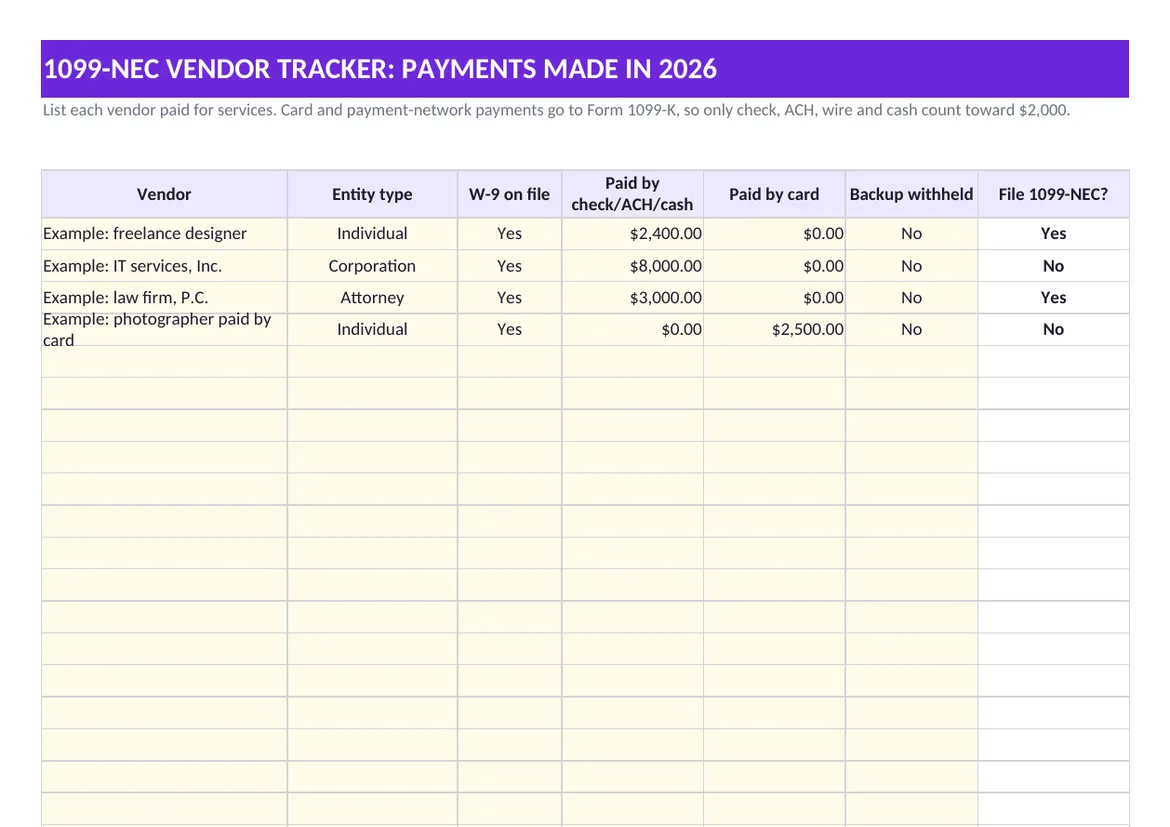
The download is the 1099-NEC vendor tracker: list each contractor paid in 2026 and it flags who needs a form. In the calculator, enter the annual wage, your state unemployment rate and wage base from your state's rate notice, yearly benefits, and the contractor's fee. The calculator returns each employer tax, the total cost of the employee and the difference. It does not decide status: if the work would be controlled like an employee's, the cheaper column does not apply.
Common mistakes
- Calling someone a contractor because they signed a contractor agreement.
- Setting a contractor's hours, tools and methods like an employee's.
- Forgetting the 1099-NEC for a contractor paid $2,000 or more in 2026.
- Assuming the federal test settles state law; state tests can be stricter.
- Applying the 2026 wage base of $184,500 to 2027 wages; it is $192,300 from January 1, 2027.
Contractor Invoices and Timesheets in Draivix
Draivix received invoices pass through your configured approval workflow before payment, which gives one record of what was paid to each contractor during the year. Timesheets track time spent on tasks and projects, and employees' attendance goes through Time & Attendance. Draivix does not decide worker status, run U.S. payroll or file Forms 1099; your accountant or filing service does.
Last reviewed: November 23, 2026, against IRS.gov, the Federal Register and DOL.gov. This page is general information, not legal or tax advice.
Sources and legal basis
- IRS: independent contractor (self-employed) or employee? (last reviewed May 19, 2026)
- Federal Register, 91 FR 75646 (November 23, 2026): employee or independent contractor status, effective January 22, 2027
- DOL: FAQs for the 2026 employee or independent contractor final rule
- IRS Tax Topic 751: Social Security and Medicare withholding rates (last reviewed November 9, 2026)
- IRS Tax Topic 759: Form 940, FUTA tax (last reviewed November 9, 2026)
- IRS: self-employment tax (last reviewed October 30, 2026)
- Social Security Administration: contribution and benefit base ($192,300 for 2027)
Facts verified:
02Frequently Asked Questions
What is the difference between a 1099 contractor and a W-2 employee?
An employee works under the company's right to control how the work is done and gets a W-2; the employer withholds and pays payroll taxes. A contractor runs an independent business, gets a 1099-NEC if paid $2,000 or more in 2026, and pays self-employment tax.
Is it cheaper to hire a 1099 contractor?
Not always. The employer saves 7.65% Social Security and Medicare, FUTA and state unemployment tax, but contractors usually charge more per hour. A $60,000 employee costs $64,632 in federal employer taxes and wages (computed); a contractor quoting $66,000 costs more.
When does the new DOL independent contractor rule take effect?
On January 22, 2027. It was published in the Federal Register on November 23, 2026 and rescinds the 2024 rule. The two core factors are control over the work and the worker's opportunity for profit or loss.
Which test does the IRS use?
The common-law test: behavioral control, financial control and the type of relationship. The new DOL rule does not change it. Either party can ask the IRS for a determination on Form SS-8.
Can a worker be a contractor under federal law and an employee under state law?
Yes. The DOL says its rule has no effect on state tests such as California's and New Jersey's ABC tests, and employers must comply with the standard that protects workers more.
What is the Social Security wage base for 2027?
$192,300 for earnings in 2027, according to the Social Security Administration, up from $184,500 in 2026. Employer and employee each pay 6.2% on wages up to that amount, at most $11,922.60 each.
03More Free Tools
Related Templates & Calculators
- 2027 Payroll Calendar: Weekly, Biweekly, SemimonthlyFree 2027 payroll calendar in Excel and PDF: 53 weekly Fridays, 26 or 27 biweekly paydays and 24 semimonthly dates, each moved off bank holidays.Open
- Statement of Work Template: Free SOW in Excel and PDFFree statement of work template in Excel and PDF: scope, deliverables with acceptance criteria, milestones that add up to the fee, assumptions and sign-off.Open
- Purchase Requisition Template: Excel Form and ApprovalsFree purchase requisition template in Excel and PDF: line items that total with shipping, a budget code, approval limits by amount and the path to a PO.Open
- Indiana Minimum Wage 2027: $7.25, Overtime, Final PayIndiana minimum wage stays $7.25 in 2027 for employers with 2+ employees. Tipped $2.13, training wage, overtime, semimonthly pay, final pay, deductions.Open
Let’s start together
Tell us how your business works.
We will show you what a system that takes over part of that work could look like.
Book a consultation