
01Free Online Calculator + Excel Workbook
U.S. Minimum Wage by State 2027: Every Rate on January 1, 2027
Minimum wage by state for 2027: the 2026 rate and the January 1, 2027 rate for all 50 states and DC from official sources, with a checker and Excel table.
Minimum Wage Check: Any State, 2026 or 2027
Uses the state rate and time and a half after 40 hours a week; tipped, youth, training and industry rates, local ordinances and daily overtime rules are not included, so check the rules on this page for your case.
On January 1, 2027, the minimum wage rises in 16 states: Arizona ($15.65), California ($17.40), Colorado ($15.71), Connecticut ($17.48), Maine ($15.70), Michigan ($15.00), Minnesota ($11.87), Montana ($11.20), Nebraska ($15.26), New Jersey ($16.48), Ohio ($11.40), Rhode Island ($17.00), South Dakota ($12.30), Vermont ($14.91), Virginia ($13.75) and Washington ($17.73). The federal minimum wage stays at $7.25 an hour. Missouri stays at $15.00 because HB 567 ended its yearly increase, and New York keeps $17.00 and $16.00.
Every 2026 rate below comes from the U.S. Department of Labor state table, updated November 5, 2026. Every 2027 rate comes from the state's own release, statute or poster, linked in the sources at the end of this page. When a news story and the official notice disagree, the table follows the official notice. Where a state adjusts its rate but had not published the 2027 figure on November 23, 2026, the row says so instead of guessing.
Minimum Wage by State: 2026 and January 1, 2027
| State | 2026 rate | January 1, 2027 | Note |
|---|---|---|---|
| Alabama | $7.25 | $7.25 | No state law; federal rate |
| Alaska | $14.00 | $14.00 | $15.00 from July 1, 2027 (AS 23.10.065) |
| Arizona | $15.15 | $15.65 | Industrial Commission 2027 poster |
| Arkansas | $11.00 | $11.00 | 4+ employees |
| California | $16.90 | $17.40 | DIR release; many cities are higher |
| Colorado | $15.16 | $15.71 | CDLE release; Denver $19.84 |
| Connecticut | $16.94 | $17.48 | Governor's release, August 5, 2026 |
| Delaware | $15.00 | $15.00 | No 2027 change read |
| District of Columbia | $18.40 | $18.40 | Changes each July 1 |
| Florida | $15.00 | $15.00 | $15.00 since September 30, 2026; indexing starts January 1, 2028 |
| Georgia | $7.25 | $7.25 | State $5.15; FLSA employers $7.25 |
| Hawaii | $16.00 | $16.00 | $18.00 from January 1, 2028 |
| Idaho | $7.25 | $7.25 | |
| Illinois | $15.00 | $15.00 | Chicago sets its own rate |
| Indiana | $7.25 | $7.25 | 2+ employees |
| Iowa | $7.25 | $7.25 | |
| Kansas | $7.25 | $7.25 | |
| Kentucky | $7.25 | $7.25 | |
| Louisiana | $7.25 | $7.25 | No state law; federal rate |
| Maine | $15.10 | $15.70 | Maine DOL, September 18, 2026 |
| Maryland | $15.00 | $15.00 | Three counties are higher |
| Massachusetts | $15.00 | $15.00 | |
| Michigan | $13.73 | $15.00 | MCL 408.934; 2+ employees |
| Minnesota | $11.41 | $11.87 | Minnesota DLI; Minneapolis $17.02 |
| Mississippi | $7.25 | $7.25 | No state law; federal rate |
| Missouri | $15.00 | $15.00 | HB 567 ended CPI indexing |
| Montana | $10.85 | $11.20 | Montana DLI; sales over $110,000 |
| Nebraska | $15.00 | $15.26 | LB 258, +1.75% a year; 4+ employees |
| Nevada | $12.00 | $12.00 | |
| New Hampshire | $7.25 | $7.25 | |
| New Jersey | $15.92 | $16.48 | NJDOL release, September 29, 2026 |
| New Mexico | $12.00 | $12.00 | |
| New York | $17.00 / $16.00 | $17.00 / $16.00 | NYC, Long Island, Westchester / rest of state |
| North Carolina | $7.25 | $7.25 | |
| North Dakota | $7.25 | $7.25 | |
| Ohio | $11.00 | $11.40 | 2027 poster; receipts $419,000+ |
| Oklahoma | $7.25 | $7.25 | |
| Oregon | $15.55 | $15.55 | Changes each July 1; Portland $16.80 |
| Pennsylvania | $7.25 | $7.25 | |
| Rhode Island | $16.00 | $17.00 | R.I. Gen. Laws § 28-12-3 |
| South Carolina | $7.25 | $7.25 | No state law; federal rate |
| South Dakota | $11.85 | $12.30 | South Dakota DLR |
| Tennessee | $7.25 | $7.25 | No state law; federal rate |
| Texas | $7.25 | $7.25 | |
| Utah | $7.25 | $7.25 | |
| Vermont | $14.42 | $14.91 | Vermont DOL; tipped $7.46 |
| Virginia | $12.77 | $13.75 | Va. Code § 40.1-28.10 |
| Washington | $17.13 | $17.73 | L&I release 26-17 |
| West Virginia | $8.75 | $8.75 | 6+ employees at one location |
| Wisconsin | $7.25 | $7.25 | Tipped $2.33 |
| Wyoming | $7.25 | $7.25 | State $5.15; FLSA employers $7.25 |
Rates are for non-tipped adult employees of covered employers. A state guide is linked where Draivix has one. Where a state rate is lower than $7.25 or the state has no law, an employer covered by the federal Fair Labor Standards Act pays at least $7.25. Where federal and state rates differ, the employee gets the higher one.
Rates That Change on a Date Other Than January 1
| Place | Current rate | Next change |
|---|---|---|
| Alaska | $14.00 since July 1, 2026 | $15.00 on July 1, 2027 (AS 23.10.065); indexed from 2028 |
| District of Columbia | $18.40 since July 1, 2026 | July 1, 2027; not yet published |
| Oregon | $15.55 standard, $16.80 Portland metro, $14.55 nonurban (July 1, 2026) | July 1, 2027; BOLI publishes the rate by April 30 |
| Maryland: Montgomery County | $18.00 (51+ employees), $16.50 (11 to 50), $15.95 (10 or fewer) | July 1, 2027, by CPI-W |
| Maryland: Howard County | $16.00 since July 1, 2026 | Not read |
| Maryland: Prince George's County | $15.30 since July 1, 2026 | Not read |
| Hawaii | $16.00 since January 1, 2026 | $18.00 on January 1, 2028 |
| Virginia | $13.75 from January 1, 2027 | $15.00 on January 1, 2028 |
| Florida | $15.00 since September 30, 2026 | Annual indexing from January 1, 2028 |
Worked Example: One Week in Michigan Before and After January 1
An employee in Michigan earns $14.50 an hour and works 45 hours in the first full week of January 2027. Michigan's minimum becomes $15.00 on January 1, 2027, so the rate is $0.50 too low. Lawful pay for the week is 40 × $15.00 = $600.00 plus 5 overtime hours × $22.50 = $112.50, so $712.50. At $14.50 the employer pays 40 × $14.50 + 5 × $21.75 = $688.75, which is $23.75 short for that one week. The checker above gives the same figures.
The same employee in Pennsylvania, North Carolina or Texas is above the $7.25 minimum and needs no change, but still gets time and a half after 40 hours under federal law (DOL Fact Sheet #23).
How to Use the Checker and the Excel Table
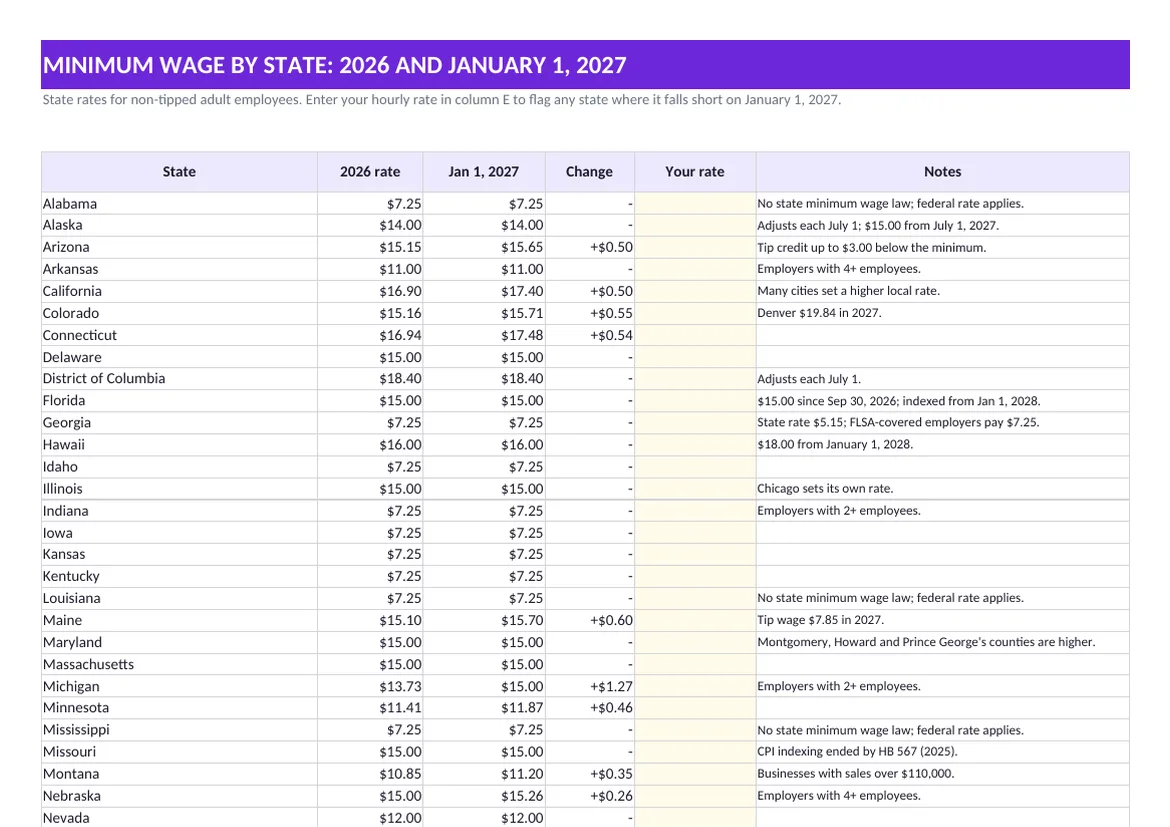
In the checker, choose the state (or the county or tier where a state has more than one rate), pick 2026 or January 1, 2027, and enter your hourly rate and weekly hours. It returns the minimum, whether your rate meets it, the week's pay with overtime after 40 hours and any shortfall. The Excel table has every state in one sheet: type your rate in the yellow column and every state where it falls short is marked BELOW THE MINIMUM. It prints on one US Letter page.
Common mistakes before the first 2027 payroll
- Updating the rate on the first payday in January instead of for hours worked from January 1. A pay period that spans December 31 uses two rates.
- Forgetting tipped cash wages. In states with a tip credit, the cash wage often rises with the minimum, for example New Jersey's from $6.05 to $6.61.
- Missing a local rate. Cities and counties in California, Colorado, Washington, Maryland, Illinois and other states set higher rates than the state.
- Leaving exempt salaries below the new state threshold. California's exempt salary is $72,384 a year in 2027, and Maine's is $905.79 a week.
- Treating the federal $7.25 as the floor in a state that pays more. The higher rate always wins.
Federal Rules That Apply in Every State
| Topic | Federal rule | Source |
|---|---|---|
| Minimum wage | $7.25 an hour | DOL state table |
| Tipped employees | Cash wage at least $2.13 an hour; maximum tip credit $5.12 | Fact Sheet #15 |
| Overtime | 1.5 × the regular rate after 40 hours in a workweek | Fact Sheet #23 |
| Exempt salary level | $684 a week ($35,568 a year); highly compensated $107,432 | DOL salary levels |
| Breaks | Not required; short breaks of 5 to 20 minutes that an employer offers are paid time | DOL breaks |
| Payroll records | Keep payroll records 3 years and time cards 2 years | Fact Sheet #21 |
Hours are the other half of every minimum wage check. Draivix Time & Attendance records clock ins and clock outs and builds the timesheet a supervisor approves; payroll inputs pull the hours worked from the month's attendance sheet; the rates and overtime rules of the states you operate in are configured for your company when the system is tailored to you. Draivix does not pay wages or file payroll taxes.
Last reviewed: November 23, 2026. This page summarizes general rules for private employers and is not legal advice. Cities, counties and some industries set their own rules; check the linked source before you change pay.
Sources and legal basis
- U.S. Department of Labor: state minimum wage laws (updated November 5, 2026)
- Arizona Industrial Commission: 2027 minimum wage poster
- California DIR news release 2026-66
- Colorado CDLE: minimum wage will increase to $15.71 in 2027
- Connecticut Governor: minimum wage will increase (August 5, 2026)
- Maine DOL: minimum wage to increase to $15.70 in 2027
- Michigan LEO: minimum wage
- Minnesota DLI: minimum wage
- Missouri Department of Labor: minimum wage
- Montana DLI: state minimum wage
- Nebraska Attorney General Opinion 26-003
- New Jersey DOL release, September 29, 2026
- New York DOL: minimum wage
- Ohio Department of Commerce: 2027 minimum wage poster
- Oregon BOLI: minimum wage schedule
- Rhode Island General Laws § 28-12-3
- South Dakota DLR: minimum wage
- Vermont Department of Labor: rights and wages (rate effective January 1, 2027)
- Code of Virginia § 40.1-28.10
- Washington L&I news release 26-17
- Hawaii DLIR: minimum wage
- Alaska DOLWD: wage and hour
- Alaska Statutes § 23.10.065: minimum wages
- Maryland DOL: wage and hour facts
- DOL Fact Sheet #15: tipped employees under the FLSA
- DOL Fact Sheet #23: overtime pay under the FLSA
- DOL: overtime salary levels
Facts verified:
02Frequently Asked Questions
What is the federal minimum wage in 2027?
The federal minimum wage stays $7.25 an hour in 2027. Congress has not changed it, and the Department of Labor's state table of November 5, 2026 lists no federal change. States and cities can set higher rates, and the employee gets the higher one.
Which states raise the minimum wage on January 1, 2027?
Sixteen states: Arizona, California, Colorado, Connecticut, Maine, Michigan, Minnesota, Montana, Nebraska, New Jersey, Ohio, Rhode Island, South Dakota, Vermont, Virginia and Washington. Michigan has the largest jump, from $13.73 to $15.00. Alaska follows on July 1, 2027, when its rate rises to $15.00.
Which state has the highest minimum wage in 2027?
Washington, at $17.73 an hour from January 1, 2027. The District of Columbia is higher at $18.40, and some cities and counties go further, for example Denver at $19.84 in 2027. California follows at $17.40 statewide.
Does Missouri's minimum wage go up in 2027?
No. Missouri reached $15.00 on January 1, 2026, and HB 567, signed July 10, 2025, ended the annual adjustment by the Consumer Price Index. The rate stays $15.00 in 2027 unless the law changes again.
Do I pay the new rate from January 1 or from the first payday of 2027?
From the first hour worked on January 1, 2027. If a pay period runs from December 27 to January 9, hours worked through December 31 use the 2026 rate and hours from January 1 use the 2027 rate. Your time records need the date of each shift to split the period correctly.
What if my state has no minimum wage law?
Alabama, Louisiana, Mississippi, South Carolina and Tennessee have no state minimum wage law. Employers covered by the Fair Labor Standards Act pay at least the federal $7.25 an hour there, plus time and a half after 40 hours a week.
03More Free Tools
Related Templates & Calculators
- Michigan Minimum Wage 2027: $15.00 and Tipped RateMichigan minimum wage rises to $15.00 on January 1, 2027. Tipped wage at 42%, overtime after 40 hours, final pay and earned sick time, with a wage checker.Open
- New Jersey Minimum Wage 2027: $16.48 and All RatesNew Jersey minimum wage is $16.48 from January 1, 2027, with separate rates for small, seasonal, farm and tipped workers. Overtime, sick leave, final pay.Open
- Ohio Minimum Wage 2027: $11.40 and Tipped $5.70Ohio minimum wage is $11.40 from January 1, 2027 and $5.70 plus tips for tipped staff. Who pays $7.25 under the $419,000 rule, overtime, records and paydays.Open
- Virginia Minimum Wage 2027: $13.75 and the 2028 StepVirginia minimum wage is $13.75 from January 1, 2027 and $15.00 from 2028. Farm workers are newly covered, plus tipped, training wage, overtime and final pay.Open
Let’s start together
Tell us how your business works.
We will show you what a system that takes over part of that work could look like.
Book a consultation