
01Free Online Calculator + Excel Workbook
States With No Income Tax: What Employers Withhold, and What They Still Owe
Nine states do not tax wages: AK, FL, NV, NH, SD, TN, TX, WA and WY. What employers there still withhold, the payroll taxes they owe, and remote workers.
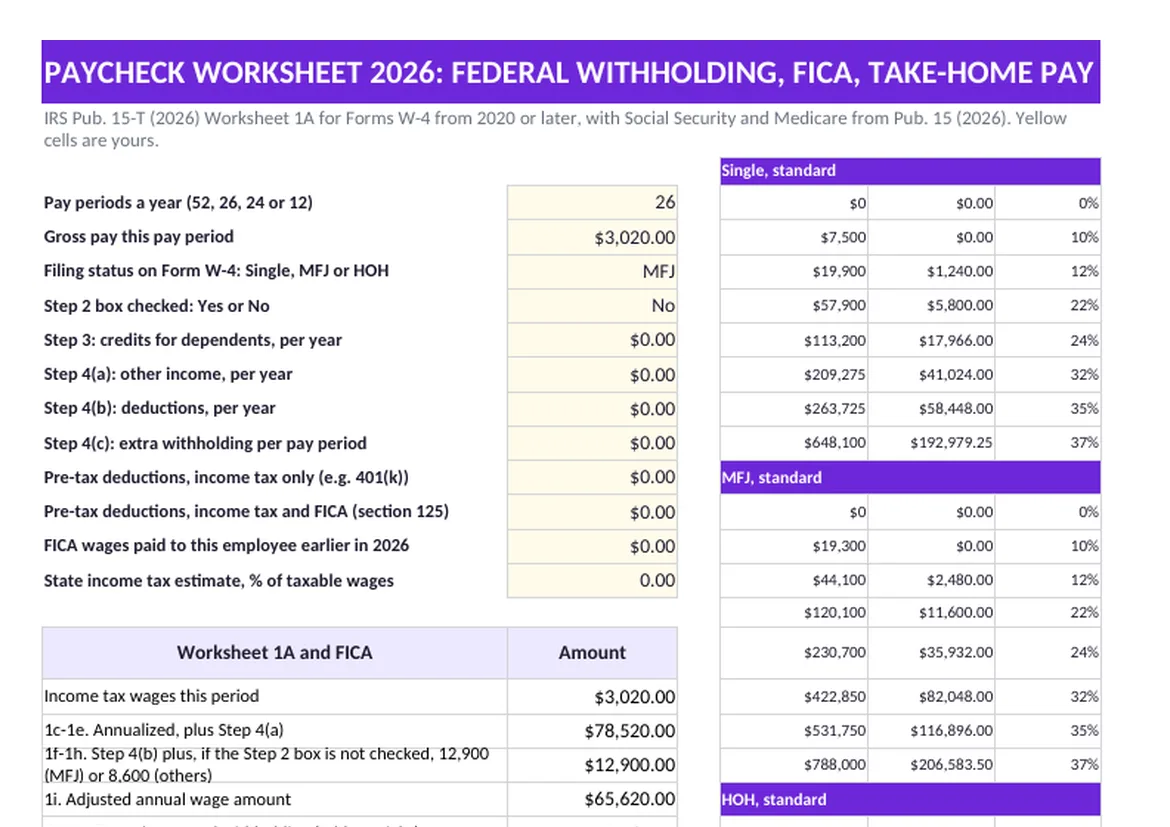
Paycheck Calculator: Federal Withholding, Social Security, Medicare, Take-Home Pay
Federal withholding follows IRS Publication 15-T (2026), Worksheet 1A, for Forms W-4 from 2020 or later; Social Security and Medicare follow Publication 15 (2026). State tax is your own flat estimate, not a state withholding table, and local taxes, garnishments and after-tax deductions are not included.
As of November 23, 2026, nine states do not tax wages: Alaska, Florida, Nevada, New Hampshire, South Dakota, Tennessee, Texas, Washington and Wyoming. An employer there withholds no state income tax from an employee who lives and works in the state, but still withholds federal income tax, Social Security and Medicare, still pays federal and state unemployment tax, and in some of these states owes a payroll tax or paid-leave premium under another name.
New Hampshire and Tennessee once taxed interest and dividends but never wages, and both taxes are repealed. Washington taxes certain long-term capital gains and has enacted a tax on very high incomes from 2028, but neither is withheld from wages.
The Nine States and the Rule Behind Each
| State | Wage income tax | Rule as read on November 23, 2026 |
|---|---|---|
| Alaska | None | The individual income tax chapter does not apply to individuals: AS 43.20.012(a)(1) |
| Florida | None | The constitution bars a tax on the income of natural persons beyond limits tied to federal credits: Fla. Const. Art. VII, § 5(a) |
| Nevada | None | "No income tax shall be levied upon the wages or personal income of natural persons": Nev. Const. Art. 10, § 1(9) |
| New Hampshire | None | The Interest and Dividends Tax is repealed for taxable periods beginning after December 31, 2024: NH DRA |
| South Dakota | None | The Department of Revenue states South Dakota does not impose a state income tax: SD DOR |
| Tennessee | None | The Hall income tax on interest and dividends is repealed for tax periods beginning on or after January 1, 2021: TN DOR |
| Texas | None | The constitution prohibits a tax on the net incomes of individuals (§ 24-a, added in 2019): Tex. Const. Art. 8, § 24-a |
| Washington | None on wages | "Washington does not currently have an individual income tax"; a 9.9% tax on adjusted gross income over $1 million (SB 6346) begins January 1, 2028, with first returns due in April 2029: WA DOR |
| Wyoming | None | No statute levies an individual income tax: the Legislative Service Office lists it at 0% with $0 collected in fiscal year 2024 (Wyoming LSO). The constitution does not forbid one, but any tax on income would have to allow full credit for sales, use and property taxes paid in Wyoming (Wyo. Const. Art. 15, § 18) |
What Employers in These States Still Owe
| Topic | Rule | Source |
|---|---|---|
| Federal income tax | Withheld from every employee by the Form W-4 and Pub. 15-T, in every state | Pub. 15-T (2026) |
| Social Security and Medicare | 6.2% and 1.45% from the employee and the same from the employer; 0.9% Additional Medicare over $200,000 | Pub. 15 (2026) |
| Unemployment | Federal FUTA tax with a credit for state unemployment tax paid; every state runs its own unemployment insurance program | IRS Topic 759 |
| Alaska | Employees also pay unemployment contributions, set by statute between 0.5% and 1% of wages | AS 23.20.290(d) |
| Nevada | Modified Business Tax paid by the employer on gross wages less qualified health benefits: 1.17% for general business from July 1, 2023, with the first $50,000 of wages a quarter not taxed; 1.554% for financial institutions | NV Department of Taxation |
| Washington: paid leave | Paid Family and Medical Leave premium 1.13% of wages up to $184,500 in 2026, of which the employer may withhold up to 71.43% from the employee; from January 1, 2027, 1.2%, of which up to 70.7%. Employers with fewer than 50 employees in Washington owe no employer share | Paid Leave toolkit v25.1; Paid Leave 2027 rate |
| Washington: long-term care | WA Cares premium 0.58% of all gross wages, paid by the employee and withheld by the employer, with no wage cap | WA Cares Fund |
| Washington: capital gains | 7% on certain long-term capital gains above the standard deduction ($278,000 for 2025), plus 2.9% on the part above $1,000,000 from 2025, paid by the individual, not withheld | WA DOR; RCW 82.87.040 |
Remote Employees and Reciprocity
Where the employee works and lives decides state withholding, under each state's own law. A Texas company whose employee works from Pennsylvania withholds Pennsylvania tax: the Pennsylvania Department of Revenue requires employers to withhold its 3.07% tax from residents and nonresidents who earn income in Pennsylvania. An employee who lives and works in one of the nine states needs no state income tax withholding, even if the employer is based elsewhere.
Reciprocal agreements let an employee who lives in one state and works in another be withheld for the home state only, and they exist only between states that tax wages. Pennsylvania, for example, lists agreements with Indiana, Maryland, New Jersey, Ohio, Virginia and West Virginia, and the employee files a form (REV-419) with the employer. None of the nine states appears in that list, because there is no wage tax to exempt. Check the revenue department of the state where the work is done before you hire there.
Worked example
Two employees each earn $3,020 every two weeks and are married filing jointly on a 2026 Form W-4 with no other entries. The one in Texas takes home $2,594.26 after $194.71 of federal income tax, $187.24 of Social Security and $43.79 of Medicare, with 0% in the calculator's state field. The one in Washington also pays WA Cares of 0.58% × $3,020 = $17.52 and the employee share of the paid-leave premium, 1.13% × 71.43% × $3,020 = $24.38 (both computed), so the Washington take-home pay is $2,552.36 before any other deduction.
Hours, Approvals and Payroll Inputs
Draivix Time & Attendance records clock ins and clock outs and builds the monthly timesheet a manager approves; payroll inputs pull the hours worked from the month's attendance sheet, add bonuses a director approves and notify the payroll accountant. The module page states plainly that it does not calculate net pay or statutory deductions: Draivix does not withhold or file U.S. taxes, so the withholding on this page is done by your payroll provider or accountant, from hours that were recorded and approved in one place.
Last reviewed: November 23, 2026. This page summarizes state tax rules for employers as read on that date and is not tax advice; check the linked state source before you set up payroll in a new state.
Sources and legal basis
- Alaska Statutes § 43.20.012: tax not applicable to individuals
- Florida Constitution, Art. VII, § 5 (Florida Senate)
- Nevada Constitution, Art. 10, § 1(9) (Nevada Legislature, Wayback capture of November 2, 2026)
- New Hampshire Department of Revenue Administration: Interest and Dividends Tax (Wayback capture of November 1, 2026)
- South Dakota Department of Revenue: taxes for individuals
- Tennessee Department of Revenue: Hall income tax (Wayback capture of November 1, 2026)
- Texas Constitution, Art. 8, § 24-a (Texas Legislative Council)
- Washington Department of Revenue: income tax
- Washington Department of Revenue: income tax FAQ
- Wyoming Legislative Service Office: Wyoming statutory tax structure, rates and collections (June 3, 2025; Wayback capture of April 14, 2026)
- Wyoming Constitution, Art. 15, § 18 (Secretary of State compilation through November 18, 2024; Wayback capture of November 3, 2026)
- Nevada Department of Taxation: Modified Business Tax
- Washington Paid Leave: employer wage reporting and premiums toolkit v25.1 (June 26, 2026)
- Washington Paid Leave: 2027 premium rate of 1.2% (updates page)
- WA Cares Fund: employers
- Washington Department of Revenue: capital gains tax
- RCW 82.87.040: capital gains tax rates (7%, plus 2.9% above $1,000,000 from 2025)
- Alaska Statutes § 23.20.290: employee unemployment contributions
- Pennsylvania Department of Revenue: employer withholding
- IRS Publication 15 (2026), (Circular E), Employer's Tax Guide
Facts verified:
02Frequently Asked Questions
Which states have no state income tax?
As of November 23, 2026: Alaska, Florida, Nevada, New Hampshire, South Dakota, Tennessee, Texas, Washington and Wyoming. New Hampshire's tax on interest and dividends was repealed for periods beginning after 2024, and Tennessee's Hall tax from 2021.
Do employers in Texas or Florida withhold any state tax?
No state income tax for employees who work there. They still withhold federal income tax, Social Security and Medicare, and pay federal and state unemployment tax.
Does Washington have an income tax now?
Not on wages. The Department of Revenue says Washington does not currently have an individual income tax; a 9.9% tax on income over $1 million starts January 1, 2028. Employers do withhold the paid-leave premium and the WA Cares premium from wages.
Is New Hampshire a no-income-tax state?
Yes for wages. New Hampshire never taxed wages, and its Interest and Dividends Tax is repealed for taxable periods beginning after December 31, 2024.
What if my remote employee lives in a state with income tax?
Generally you withhold for the state where the work is done, under that state's rules, and you may need to register there. Pennsylvania, for example, requires withholding from anyone earning income in Pennsylvania.
Do no-income-tax states have other payroll taxes?
Some do. Nevada charges employers a Modified Business Tax on wages, Alaska employees pay unemployment contributions, and Washington has paid-leave and WA Cares premiums. All states have unemployment insurance.
03More Free Tools
Related Templates & Calculators
- South Dakota Minimum Wage 2027: $12.30 and Tipped $6.15South Dakota minimum wage rises to $12.30 on January 1, 2027, and the tipped cash wage to $6.15. Overtime, breaks, paydays and final pay rules from the SDCL.Open
- Alaska Minimum Wage: $14.00, Then $15.00 July 1, 2027Alaska minimum wage is $14.00 and rises to $15.00 on July 1, 2027, with no tip credit. Daily overtime after 8 hours, paid sick leave and final pay deadlines.Open
- Final Paycheck Laws by State: Deadlines and PenaltiesWhen final pay is due in all 50 states and DC after a firing, a layoff or a resignation, which states require vacation payout, and the late-pay penalties.Open
- Estimate Template: Free Contractor Estimate (Excel, PDF)Free estimate template for contractors and service businesses in Excel and PDF: line items, taxable materials, sales tax, a not-to-exceed amount and deposit.Open
Let’s start together
Tell us how your business works.
We will show you what a system that takes over part of that work could look like.
Book a consultation