
01Free Online Calculator + Excel Workbook
Decimal Hours Converter: Minutes to Decimal Chart for Payroll
Convert hours and minutes to decimal hours for payroll and back, with a printable minutes to decimal chart and the federal rule on rounding time clock punches.
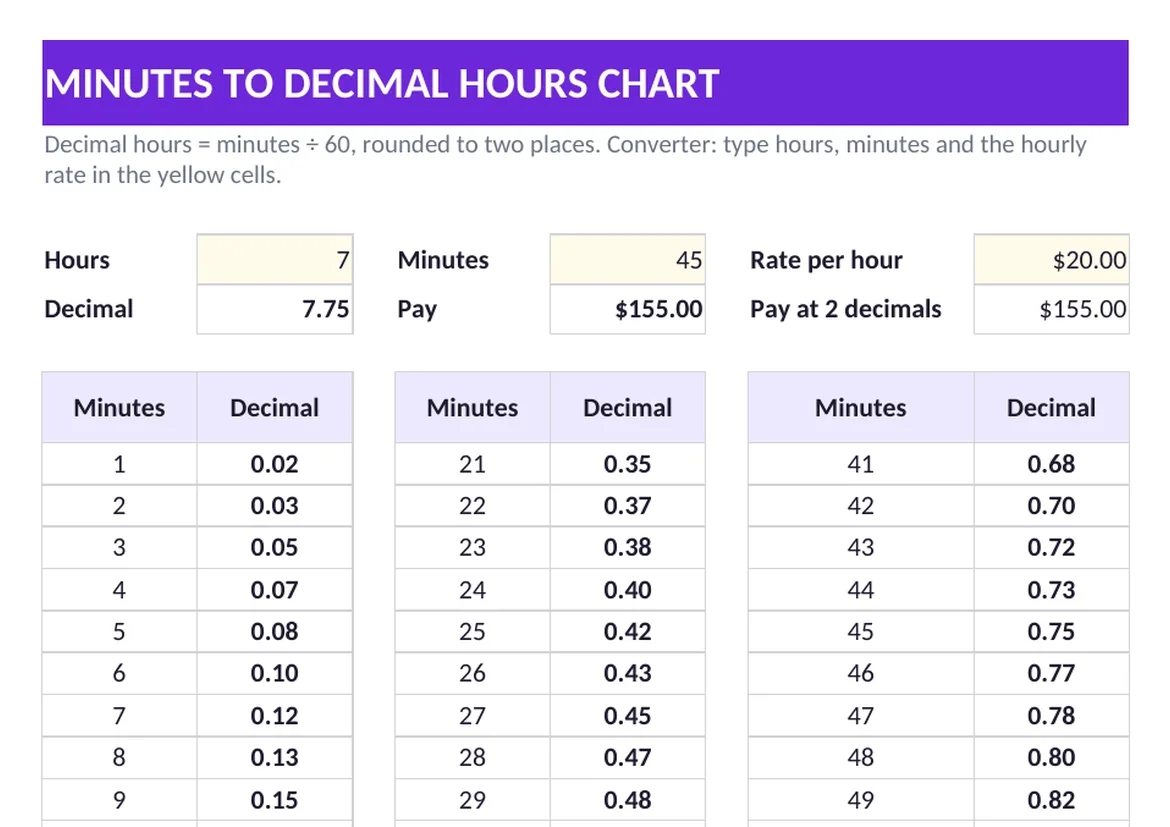
Decimal Hours Converter
Converts time with minutes ÷ 60 and rounds the decimal to two places; it does not round clock punches, which the employer's own rounding policy and 29 CFR 785.48 govern.
To turn hours and minutes into decimal hours, divide the minutes by 60 and add them to the hours: 7 hours 45 minutes is 7 + 45 ÷ 60 = 7.75 hours, and 8 hours 20 minutes is 8.33. To go back, multiply the decimal part by 60: 7.6 hours is 7 hours 36 minutes. Payroll needs decimals because the wage is multiplied by hours, and 7:45 × $20 is not a number a calculator understands.
Federal law asks for hours worked each workday and the total for each workweek (29 CFR 516.2). It allows rounding of time clock punches to the nearest 5 minutes, tenth or quarter of an hour only if, over time, employees are paid for all the time they actually worked (29 CFR 785.48(b)).
Minutes to Decimal Hours Chart
| Minutes | Decimal | Minutes | Decimal | Minutes | Decimal |
|---|---|---|---|---|---|
| 1 | 0.02 | 21 | 0.35 | 41 | 0.68 |
| 2 | 0.03 | 22 | 0.37 | 42 | 0.70 |
| 3 | 0.05 | 23 | 0.38 | 43 | 0.72 |
| 5 | 0.08 | 25 | 0.42 | 45 | 0.75 |
| 6 | 0.10 | 26 | 0.43 | 46 | 0.77 |
| 10 | 0.17 | 30 | 0.50 | 50 | 0.83 |
| 12 | 0.20 | 32 | 0.53 | 52 | 0.87 |
| 15 | 0.25 | 35 | 0.58 | 55 | 0.92 |
| 18 | 0.30 | 36 | 0.60 | 57 | 0.95 |
| 20 | 0.33 | 40 | 0.67 | 59 | 0.98 |
Computed as minutes ÷ 60, rounded to two decimals. The printable chart lists every minute from 1 to 60 and adds a converter with yellow cells for hours and minutes.
Rounding Time Clock Punches: What the Federal Rule Allows
| Practice | Federal rule | Source |
|---|---|---|
| Rounding punches to the nearest 5 minutes, tenth or quarter hour | Accepted for enforcement if it does not, over time, leave employees underpaid for time actually worked | 29 CFR 785.48(b) |
| Early or late punches with no work done | Need not be paid; the punch time may be disregarded | 29 CFR 785.48(a) |
| A few seconds or minutes that cannot practically be recorded | May be disregarded as de minimis only for uncertain, indefinite periods; scheduled working time may not be ignored however small | 29 CFR 785.47 |
| Time clocks | Not required | 29 CFR 785.48(a) |
| Records | Hours worked each workday and total hours each workweek; time cards kept 2 years | 29 CFR 516.2, Fact Sheet #21 |
Rounding to the nearest increment works both ways: 7:53 to 8:00 and 8:07 to 8:00 under quarter-hour rounding. A rule that always rounds in the employer's favor does not average out and is the practice 785.48 warns against. Some states set stricter rules on rounding; check your state.
Worked Example and How to Use the Converter
An employee works 8 hours 20 minutes at $18.00 an hour. As a fraction that is 8⅓ hours and $150.00 exactly. Payroll that stores 8.33 hours pays $149.94, six cents less (computed). Over a year of such days the difference grows, so keep minutes or use enough decimals, or round the pay, not the hours, at the end.
Choose the direction, enter hours and minutes or a decimal, and optionally the hourly rate. The result shows decimal hours, hours and minutes, total minutes and the pay both ways. The Excel chart prints on one US Letter page for the payroll desk.
Common mistakes
- Writing 7:30 as 7.30 hours instead of 7.50.
- Rounding every punch in the employer's favor.
- Dropping seconds-long gaps but also whole scheduled minutes, which 785.47 does not allow.
- Adding decimal hours rounded to one place across a whole week.
- Converting break deductions in minutes but the shift in decimals.
Clock Ins and Timesheets in Draivix
Draivix Time & Attendance records each clock in and clock out from a badge terminal, a browser or a phone, pairs them into shifts and builds the timesheet a supervisor approves; corrections go through review and an approved month is locked. Payroll inputs pull the hours worked from the month's attendance sheet. For the hours of a whole week, see the time card calculator.
Last reviewed: November 23, 2026, against 29 CFR 785.47, 785.48 and 516.2 on eCFR. This page is general information, not legal advice.
02Frequently Asked Questions
How do I convert minutes to decimal hours?
Divide the minutes by 60. 15 minutes is 0.25 hours, 30 minutes 0.50, 45 minutes 0.75 and 20 minutes 0.33.
What is 7 hours and 45 minutes in decimal?
7.75 hours: 45 ÷ 60 = 0.75. At $20 an hour that is $155.00.
How do I convert decimal hours back to minutes?
Multiply the decimal part by 60. 7.6 hours is 7 hours and 0.6 × 60 = 36 minutes, so 7:36.
Is rounding time clock punches legal?
Under federal law, rounding to the nearest 5 minutes, tenth or quarter of an hour is accepted if it does not, over time, result in paying employees less than the time they actually worked (29 CFR 785.48(b)).
Is 8.33 hours the same as 8 hours 20 minutes?
Almost. 8 hours 20 minutes is 8.3333 hours; 8.33 is rounded. At $18 an hour the exact time pays $150.00 and 8.33 hours pays $149.94.
03More Free Tools
Related Templates & Calculators
- 1099 vs W-2: Contractor or Employee and the Real Cost1099 contractor or W-2 employee: the IRS common-law test, the DOL rule effective January 22, 2027, and a calculator for what each costs the employer.Open
- 2027 Payroll Calendar: Weekly, Biweekly, SemimonthlyFree 2027 payroll calendar in Excel and PDF: 53 weekly Fridays, 26 or 27 biweekly paydays and 24 semimonthly dates, each moved off bank holidays.Open
- Statement of Work Template: Free SOW in Excel and PDFFree statement of work template in Excel and PDF: scope, deliverables with acceptance criteria, milestones that add up to the fee, assumptions and sign-off.Open
- Purchase Requisition Template: Excel Form and ApprovalsFree purchase requisition template in Excel and PDF: line items that total with shipping, a budget code, approval limits by amount and the path to a PO.Open
Let’s start together
Tell us how your business works.
We will show you what a system that takes over part of that work could look like.
Book a consultation