
01Free Online Calculator + Excel Workbook
Freight Class Calculator: Density and the NMFC 13-Class Scale
Work out cubic feet, density and the freight class from the NMFC 13-sub density scale. Pallets, drums, worked examples and when the item number still decides.
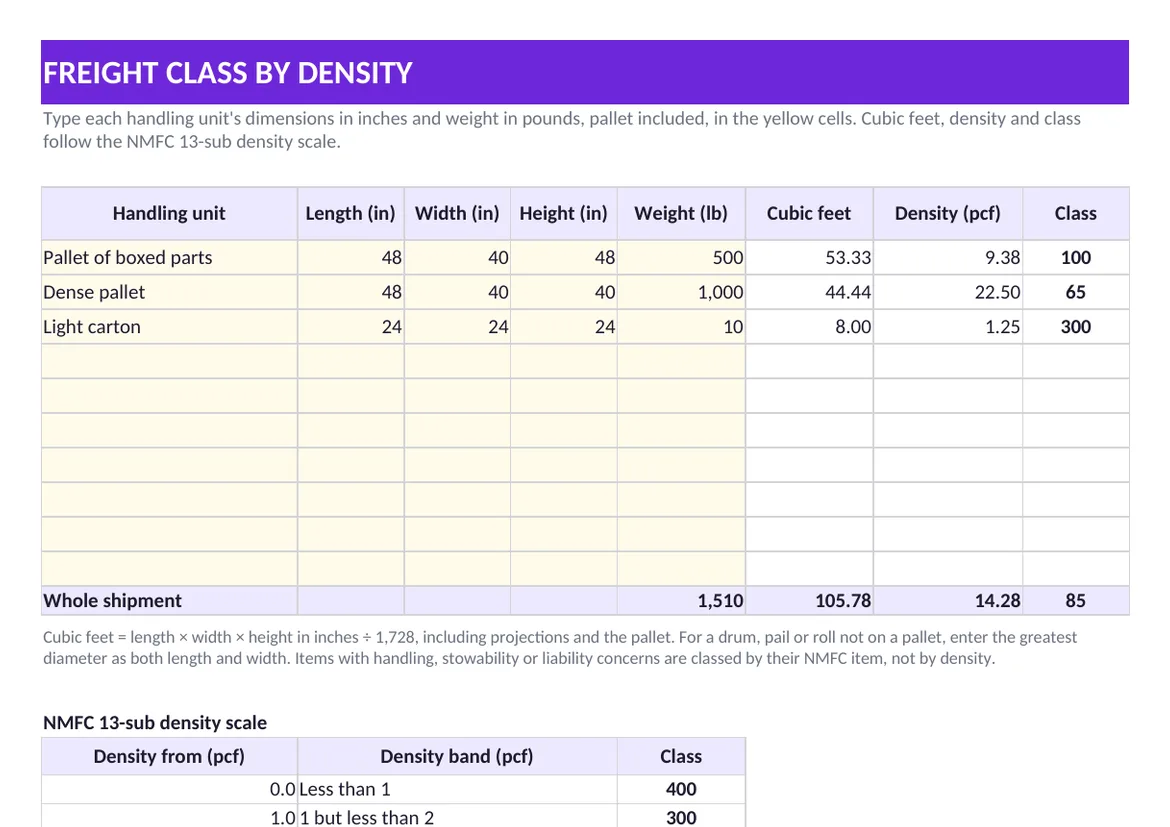
Freight Class Calculator
Applies the NMFC 13-sub density scale only; items with handling, stowability or liability concerns are classed by their NMFC item, and a carrier's tariff can apply.
Freight class by density takes three steps: measure the shipment in inches, divide length × width × height by 1,728 to get cubic feet, then divide the weight in pounds by the cubic feet. A 48 × 40 × 48 inch pallet weighing 500 lb is 53.33 cubic feet and 9.38 pounds per cubic foot, which falls in the 8-to-under-10 band of the NMFC 13-sub density scale: class 100.
The scale comes from the National Motor Freight Traffic Association (NMFTA), which publishes the National Motor Freight Classification (NMFC). Docket 2025-1 amended items to classes based on this 13-sub scale, approved in Disposition Bulletin 1371 with an effective date of July 19, 2025. The class of a real shipment still depends on its NMFC item: items with handling, stowability or liability concerns are not classed on density alone.
NMFC 13-Sub Density Scale
| Sub | Density, pounds per cubic foot | Class |
|---|---|---|
| 1 | Less than 1 | 400 |
| 2 | 1 but less than 2 | 300 |
| 3 | 2 but less than 4 | 250 |
| 4 | 4 but less than 6 | 175 |
| 5 | 6 but less than 8 | 125 |
| 6 | 8 but less than 10 | 100 |
| 7 | 10 but less than 12 | 92.5 |
| 8 | 12 but less than 15 | 85 |
| 9 | 15 but less than 22.5 | 70 |
| 10 | 22.5 but less than 30 | 65 |
| 11 | 30 but less than 35 | 60 |
| 12 | 35 but less than 50 | 55 |
| 13 | 50 or greater | 50 |
Source: NMFTA Docket 2025-1, Subject 1 and Disposition Bulletin 1371. A density exactly on a boundary belongs to the higher band: 22.5 pcf is class 65, not 70.
How to Measure, by the NMFTA Rules
- Measure length, width and height as tendered to the carrier, in inches, including any projections, extensions and overhangs.
- On skids, pallets, platforms or racks, include the pallet in the dimensions and in the weight.
- For drums, pails, rolls and other cylinders not on a pallet, square the greatest diameter and multiply by the height.
- For irregular shapes, use the extreme length, width and height.
- Use the weight as tendered to the carrier, then divide it by the cubic feet.
Source: the density method in the NMFTA FCDC proposal form.
Worked Examples
| Shipment | Dimensions | Weight | Cubic feet | Density | Class |
|---|---|---|---|---|---|
| Pallet of boxed parts | 48 × 40 × 48 in | 500 lb | 53.33 | 9.38 pcf | 100 |
| Dense pallet | 48 × 40 × 40 in | 1,000 lb | 44.44 | 22.50 pcf | 65 |
| Light carton | 24 × 24 × 24 in | 10 lb | 8.00 | 1.25 pcf | 300 |
| Drum, not on a pallet | 24 in diameter × 34 in | 400 lb | 11.33 | 35.29 pcf | 55 |
Each row is computed with the rules above, and the calculator reproduces all four. The drum is measured as 24 × 24 × 34 inches, because a cylinder's cube uses the greatest diameter squared. The second pallet lands exactly on 22.5 pcf, the lower edge of class 65.
When Density Does Not Decide the Class
The NMFC is a voluntary standard for carriers, 3PLs and shippers, NMFTA says in its classification FAQs, but it is the standard to use when class is determined absent a carrier's own tariff. Density became the primary factor in 2025, yet the correct NMFC item number still matters, because items with handling, stowability or liability concerns are not classed on full density. Look up the item, check the carrier's tariff, and use the density class where the item is classed on the 13-sub scale.
Write the class and the NMFC item number on the bill of lading together with the piece count and weight.
From Measurements to Shipping Documents
The worksheet download measures up to ten handling units: type the dimensions and weight of each in the yellow cells, and live formulas return its cubic feet, density and class, plus the totals for the shipment, with the 13-sub scale on the sheet.
In Draivix warehouse management, customer shipments are warehouse documents that record every change in an immutable stock movement ledger, and with the mobile warehouse app staff issue stock by scanning barcodes. The class you work out here goes on the bill of lading you hand to the carrier.
Last reviewed: November 23, 2026. NMFC provisions and carrier tariffs decide the class of a shipment; this calculator applies the published density scale only.
Sources and legal basis
- NMFTA Docket 2025-1, Subject 1: full-scale density classifications (13-sub density scale)
- NMFTA Disposition Bulletin 1371 (March 14, 2025): Docket 2025-1 dispositions, effective July 19, 2025
- NMFTA: NMFC classification FAQs (Wayback capture of October 8, 2026)
- NMFTA FCDC proposal form: how to calculate density
Facts verified:
02Frequently Asked Questions
How do I calculate freight class?
Multiply length × width × height in inches, divide by 1,728 for cubic feet, divide the weight in pounds by the cubic feet for density, and find the density on the NMFC 13-sub scale. 9.38 pcf is class 100.
What is freight density?
Weight per cubic foot of space the shipment takes up, including the pallet. 500 lb in 53.33 cubic feet is 9.38 pounds per cubic foot.
What freight class is a standard pallet?
It depends on its density. A 48 × 40 × 48 inch pallet at 500 lb is 9.38 pcf, class 100; at 1,000 lb and 40 inches high it is 22.5 pcf, class 65.
What changed in freight classification in 2025?
NMFC Docket 2025-1, effective July 19, 2025, moved many items to classes based on a single 13-sub density scale running from class 400 under 1 pcf to class 50 at 50 pcf or more, with density as the primary factor.
Is freight class always based on density?
No. Items with handling, stowability or liability concerns are not classed on full density, and a carrier's own tariff can apply, so check the NMFC item number as well.
How do I measure a drum or roll for freight class?
If it is not on a pallet, square the greatest diameter and multiply by the height, then divide by 1,728. A 24-inch drum 34 inches tall is 11.33 cubic feet.
03More Free Tools
Related Templates & Calculators
- Paycheck Calculator 2026: Take-Home Pay After TaxesFree 2026 paycheck calculator: federal withholding by the IRS Pub. 15-T percentage method, Social Security, Medicare and take-home pay, with an Excel worksheet.Open
- W-9 Form for Businesses: Request, Verify, WithholdWhat a payer does with Form W-9: when to request it, lines 3a and 3b, TIN matching, 24% backup withholding, B notices and retention, with a vendor checklist.Open
- States With No Income Tax: A Guide for EmployersNine states do not tax wages: AK, FL, NV, NH, SD, TN, TX, WA and WY. What employers there still withhold, the payroll taxes they owe, and remote workers.Open
- South Dakota Minimum Wage 2027: $12.30 and Tipped $6.15South Dakota minimum wage rises to $12.30 on January 1, 2027, and the tipped cash wage to $6.15. Overtime, breaks, paydays and final pay rules from the SDCL.Open
Let’s start together
Tell us how your business works.
We will show you what a system that takes over part of that work could look like.
Book a consultation