
01Free Online Calculator + Excel Workbook
Paycheck Calculator 2026: Federal Withholding, Social Security, Medicare and Take-Home Pay
Free 2026 paycheck calculator: federal withholding by the IRS Pub. 15-T percentage method, Social Security, Medicare and take-home pay, with an Excel worksheet.
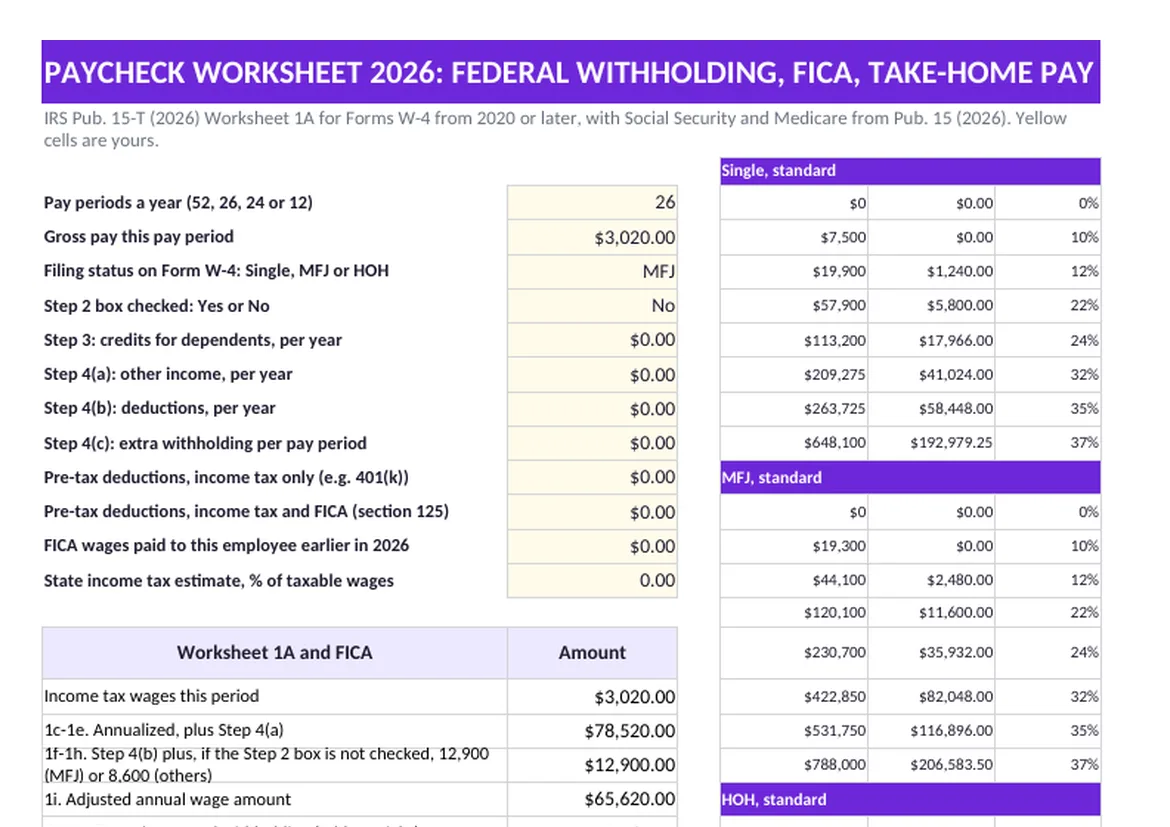
Paycheck Calculator: Federal Withholding, Social Security, Medicare, Take-Home Pay
Federal withholding follows IRS Publication 15-T (2026), Worksheet 1A, for Forms W-4 from 2020 or later; Social Security and Medicare follow Publication 15 (2026). State tax is your own flat estimate, not a state withholding table, and local taxes, garnishments and after-tax deductions are not included.
Take-home pay is gross pay minus pre-tax deductions, federal income tax withholding, Social Security (6.2%), Medicare (1.45%) and any state or local tax. For a biweekly paycheck of $3,020 to an employee who checked married filing jointly on a 2020-or-later Form W-4 and left the other steps blank, the employer withholds $194.71 of federal income tax, $187.24 of Social Security and $43.79 of Medicare, so take-home pay is $2,594.26 before any state tax.
The calculator follows the 2026 percentage method of IRS Publication 15-T for automated payroll systems, Worksheet 1A, line by line. Rounded once to the dollar, which Pub. 15-T allows if you round consistently, every result matches the IRS wage bracket tables: we tested it against all 4,794 amounts of the 2026 weekly, biweekly, semimonthly, monthly and daily tables at the middle of each bracket. The worksheet download does the same calculation in Excel with live formulas.
What the Calculator Takes From Each Rule
| Topic | Rule | Source |
|---|---|---|
| Federal income tax | Worksheet 1A: annualize the wages, add Step 4(a), subtract Step 4(b) and, if the Step 2 box is not checked, $12,900 (married filing jointly) or $8,600 (others); apply the 2026 Annual Percentage Method table; divide by the pay periods; subtract Step 3 per period; add Step 4(c) | Pub. 15-T (2026), section 1 |
| Step 2 box | A separate, narrower table applies when the employee checked the box for two jobs or a working spouse | Pub. 15-T, Worksheet 1A |
| Step 3 credits | $2,200 for each qualifying child under 17 and $500 for each other dependent, entered on the 2026 Form W-4 by an employee whose total income will be $200,000 or less ($400,000 or less if married filing jointly) | Form W-4 (2026), Step 3 |
| Rounding | The tax for the pay period may be rounded to the nearest dollar if you do it consistently | Pub. 15-T (2026) |
| Social Security | 6.2% from the employee and 6.2% from the employer, on wages up to $184,500 in 2026 | Pub. 15 (2026) |
| Medicare | 1.45% each, no wage limit; the employee alone owes 0.9% Additional Medicare on wages over $200,000 in the calendar year, starting with the pay period in which wages pass $200,000, whatever the filing status | Pub. 15 (2026) |
| 401(k) deferrals | Not subject to income tax withholding, but subject to Social Security and Medicare | Pub. 15 (2026) |
| Section 125 cafeteria plan | Qualifying benefits are generally excluded from income tax and from Social Security and Medicare wages | Pub. 15 (2026) |
Worked Example: Credits, Two Kinds of Pre-Tax Deductions and a State Estimate
Biweekly gross pay of $4,000, married filing jointly, $4,400 of Step 3 credits (two children), $25 extra withholding in Step 4(c), a $200 traditional 401(k) deferral and $100 of section 125 health premiums each paycheck, and a 4.25% state estimate. Income tax wages are $4,000 − $200 − $100 = $3,700. Annualized: $3,700 × 26 = $96,200, minus $12,900 = $83,300. In the married filing jointly table, $83,300 falls in the row from $44,100: $2,480 + 12% of $39,200 = $7,184. Less the $4,400 of credits: $2,784, divided by 26 = $107.08, plus $25 = $132.08 of federal income tax.
Social Security and Medicare are figured on $3,900, because the 401(k) deferral stays in FICA wages and the section 125 premiums do not: $241.80 and $56.55. The state estimate is 4.25% of $3,700 = $157.25. Take-home pay: $4,000 − $300 − $132.08 − $241.80 − $56.55 − $157.25 = $3,112.32. Every figure is computed by the calculator above from the cited rules.
Near the wage base
An employee paid $9,000 biweekly who has already earned $180,000 this year has only $4,500 left below the $184,500 Social Security wage base, so Social Security on this check is $279.00, not $558.00. Once year-to-date wages pass $200,000, the 0.9% Additional Medicare tax starts: a semimonthly check of $12,000 after $195,000 of earlier wages carries $63.00 of it, on the $7,000 above $200,000.
How to Use the Paycheck Calculator
Choose the pay frequency and enter gross pay for one pay period. Copy the filing status, the Step 2 box and the Step 3 and Step 4 amounts from the employee's Form W-4 exactly as written: Steps 3, 4(a) and 4(b) are annual amounts and Step 4(c) is per pay period. Enter pre-tax deductions in the right field, because a 401(k) deferral and a section 125 premium are treated differently for FICA. For Social Security and Medicare limits, enter the employee's wages earlier in the year. State tax is a flat percentage you supply; it is not a state withholding table.
The overtime and tips deductions of the 2025 tax law (P.L. 119-21) do not change these tables. An employee who expects them can lower withholding through the Step 4(b) deductions worksheet of the 2026 Form W-4; see the no tax on overtime calculator for the deduction itself. Overtime pay remains subject to Social Security and Medicare.
States without a wage income tax
Alaska, Florida, Nevada, New Hampshire, South Dakota, Tennessee, Texas, Washington and Wyoming do not tax wages, so enter 0% there; see states with no income tax for what employers in those states still owe. For the hourly equivalent of a salary, use the salary to hourly calculator, and for the difference between an employee and a contractor, 1099 vs W-2.
What it does not cover
- Forms W-4 from 2019 or earlier (allowances) and nonresident alien employees: Pub. 15-T adds separate steps and amounts for both.
- An employee who claimed exempt on Form W-4: no federal income tax is withheld, but Social Security and Medicare still are.
- Supplemental wages such as bonuses paid separately, which may use the flat 22% rate.
- Wages paid in 2027. The IRS had published only an early-release draft of the 2027 Pub. 15-T on November 23, 2026, and the Social Security wage base rises to $192,300 for 2027.
From Approved Hours to the Paycheck
Draivix Time & Attendance records clock ins and clock outs and builds the monthly timesheet a manager approves; payroll inputs pull the hours worked from the month's attendance sheet, add bonuses a director approves and notify the payroll accountant. The module page states plainly that it does not calculate net pay or statutory deductions: Draivix does not withhold or file U.S. taxes, so the withholding on this page is done by your payroll provider or accountant, from hours that were recorded and approved in one place.
Last reviewed: November 23, 2026. The calculator estimates one paycheck for wages paid in 2026 and is not tax advice; the employee's Form W-4 and your payroll provider decide the actual withholding.
Sources and legal basis
- IRS Publication 15-T (2026), Federal Income Tax Withholding Methods
- IRS: About Publication 15-T (last reviewed June 28, 2026)
- IRS Publication 15 (2026), (Circular E), Employer's Tax Guide
- IRS Form W-4 (2026), Employee's Withholding Certificate
- IRS: early-release draft of Publication 15-T for 2027 (not for filing or use)
- Social Security Administration: contribution and benefit base ($192,300 for 2027)
- IRS Tax Topic 751: Social Security and Medicare withholding rates (last reviewed November 9, 2026)
Facts verified:
02Frequently Asked Questions
How do I calculate take-home pay?
Start with gross pay, subtract pre-tax deductions, then federal income tax withholding from IRS Pub. 15-T, Social Security at 6.2%, Medicare at 1.45% (plus 0.9% over $200,000 a year) and any state and local tax. What is left is take-home pay.
How much federal tax is withheld from a $1,000 weekly paycheck?
For a single filer with a 2020-or-later Form W-4 and no other entries, about $78 in 2026: $1,000 × 52 = $52,000, minus $8,600 = $43,400; $1,240 + 12% of $23,500 = $4,060; divided by 52 = $78.08. The weekly wage bracket table shows $78 for $995 to $1,005.
Why is my paycheck withholding different from this calculator?
Usually because of a different Form W-4 entry, a pre-tax deduction, a bonus paid with the regular wages, or state and local tax. Employers may also round withholding to the nearest dollar or use the wage bracket tables, which differ from the exact percentage method by cents.
What is the Social Security wage base for 2026 and 2027?
$184,500 for 2026 and $192,300 for 2027, according to the Social Security Administration. Medicare has no wage base.
Does no tax on overtime change my paycheck?
Not automatically. The 2026 withholding tables did not change for it; an employee can enter the expected deduction in Step 4(b) of a new Form W-4 to lower withholding. Social Security and Medicare are still withheld on overtime.
Is the calculator good for 2027 paychecks?
Not yet. On November 23, 2026 the IRS had published only a draft of the 2027 Publication 15-T, which is not for use; the calculator will move to 2027 when the final publication is out.
03More Free Tools
Related Templates & Calculators
- W-9 Form for Businesses: Request, Verify, WithholdWhat a payer does with Form W-9: when to request it, lines 3a and 3b, TIN matching, 24% backup withholding, B notices and retention, with a vendor checklist.Open
- States With No Income Tax: A Guide for EmployersNine states do not tax wages: AK, FL, NV, NH, SD, TN, TX, WA and WY. What employers there still withhold, the payroll taxes they owe, and remote workers.Open
- South Dakota Minimum Wage 2027: $12.30 and Tipped $6.15South Dakota minimum wage rises to $12.30 on January 1, 2027, and the tipped cash wage to $6.15. Overtime, breaks, paydays and final pay rules from the SDCL.Open
- Alaska Minimum Wage: $14.00, Then $15.00 July 1, 2027Alaska minimum wage is $14.00 and rises to $15.00 on July 1, 2027, with no tip credit. Daily overtime after 8 hours, paid sick leave and final pay deadlines.Open
Let’s start together
Tell us how your business works.
We will show you what a system that takes over part of that work could look like.
Book a consultation