
01Free Online Calculator + Excel Workbook
Hourly to Salary Calculator: Annual Salary From an Hourly Wage, and Salary to Hourly
Annual salary calculator: turn an hourly wage into yearly, monthly, biweekly and weekly pay with overtime and unpaid weeks, or a salary into an hourly rate.
Salary to Hourly Calculator
Divides pay by the hours and paid weeks you enter, adds time and a half for hours over 40 in the hourly direction, and compares the weekly pay with the federal or Maine salary level; it does not test job duties, daily overtime under state law, state salary levels other than Maine's, or taxes.
To turn an hourly wage into an annual salary, multiply it by the hours worked in a week and by the paid weeks in a year: at 40 hours a week for 52 weeks that is 2,080 hours, so $20 an hour is $41,600 a year, $3,466.67 a month, $1,600.00 every two weeks and $800.00 a week (computed). If the job has overtime, the hours over 40 a week are paid at time and a half: $20 an hour for 45 hours a week is $950.00 a week and $49,400 a year (computed). The calculator works in both directions: an annual salary divided by the paid hours gives the hourly rate, so $50,000 a year is $24.04 an hour.
Unpaid weeks lower the annual pay of an hourly worker; paid vacation and holidays do not, because those weeks are paid. Under the federal FLSA, a salaried employee paid less than $684 a week ($35,568 a year) cannot be exempt as an executive, administrative or professional employee and is owed overtime after 40 hours, whatever the job title, unless the job is one of the few with no salary test (outside sales, teachers, practicing doctors and lawyers), and some states set a higher level, such as Maine's $905.79 a week from January 1, 2027. The calculator compares the weekly pay with either level.
Hourly to Salary: Overtime, Paid Time Off and Pay Periods
| Hourly wage | 40 h × 52 weeks | 40 h × 50 paid weeks | 45 h × 52 weeks (5 h overtime) | Biweekly at 40 h (26) | Semimonthly at 40 h (24) |
|---|---|---|---|---|---|
| $15.00 | $31,200 | $30,000 | $37,050 | $1,200.00 | $1,300.00 |
| $18.00 | $37,440 | $36,000 | $44,460 | $1,440.00 | $1,560.00 |
| $20.00 | $41,600 | $40,000 | $49,400 | $1,600.00 | $1,733.33 |
| $25.00 | $52,000 | $50,000 | $61,750 | $2,000.00 | $2,166.67 |
| $30.00 | $62,400 | $60,000 | $74,100 | $2,400.00 | $2,600.00 |
| $40.00 | $83,200 | $80,000 | $98,800 | $3,200.00 | $3,466.67 |
All amounts computed. The overtime column adds 5 hours a week at 1.5 times the wage, which is what 29 U.S.C. § 207(a)(1) requires for hours over 40 in a workweek for employees the FLSA covers and does not exempt; some states also count daily overtime, which the calculator does not. A biweekly payroll has 26 paydays in most years and a semimonthly payroll 24, so a semimonthly paycheck is larger: $41,600 ÷ 24 = $1,733.33 against $41,600 ÷ 26 = $1,600.00.
Salary to Hourly Conversion Table (40 Hours a Week, 52 Weeks)
| Annual salary | Hourly | Weekly | Biweekly (26) | Monthly (12) |
|---|---|---|---|---|
| $30,000 | $14.42 | $576.92 | $1,153.85 | $2,500.00 |
| $35,568 | $17.10 | $684.00 | $1,368.00 | $2,964.00 |
| $40,000 | $19.23 | $769.23 | $1,538.46 | $3,333.33 |
| $50,000 | $24.04 | $961.54 | $1,923.08 | $4,166.67 |
| $60,000 | $28.85 | $1,153.85 | $2,307.69 | $5,000.00 |
| $75,000 | $36.06 | $1,442.31 | $2,884.62 | $6,250.00 |
| $100,000 | $48.08 | $1,923.08 | $3,846.15 | $8,333.33 |
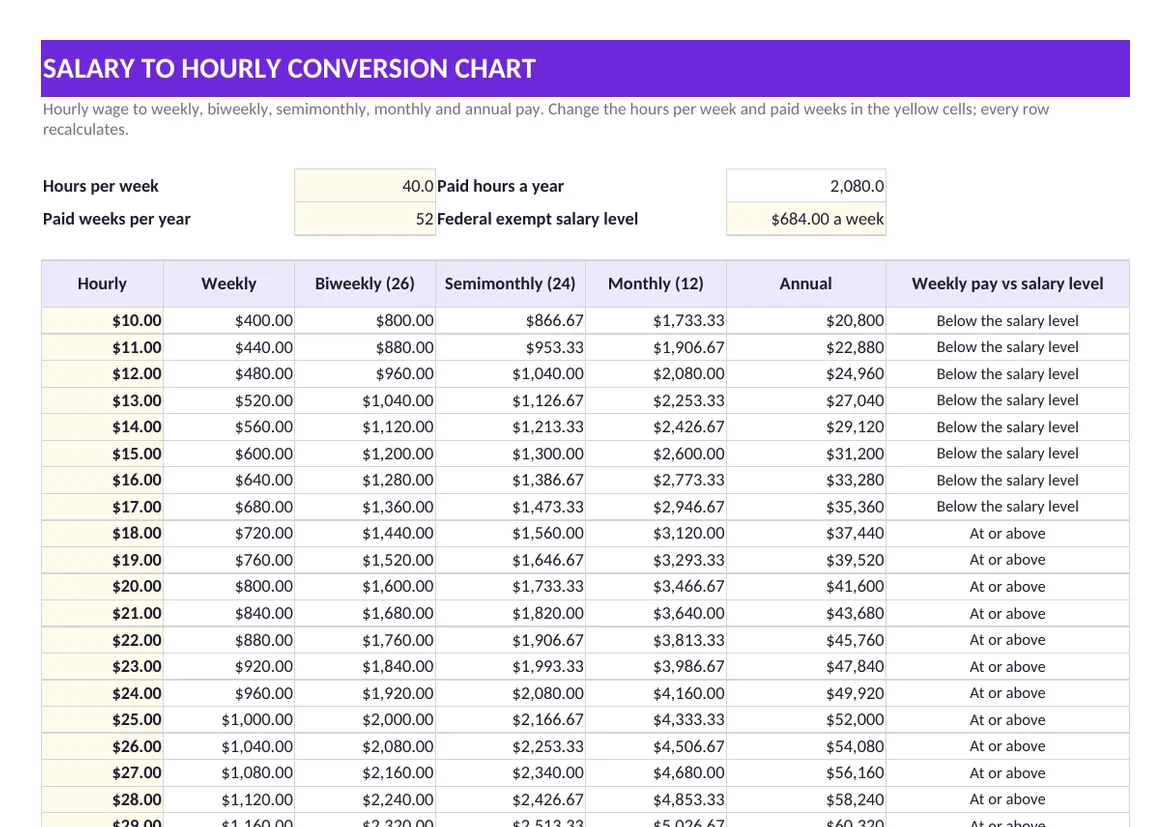
All amounts computed: annual ÷ 2,080 for the hourly wage, ÷ 52 for the week, ÷ 26 for a biweekly paycheck and ÷ 12 for a month, rounded to the cent. The Excel chart lists hourly wages from $10 to $75 with formulas you can change for other hours and weeks.
Hours, Paid Weeks and Pay Periods
A salary covers the paid weeks only. If an employee takes 2 unpaid weeks, a $52,000 salary is paid over 50 weeks, which is $26.00 for each hour worked instead of $25.00 (computed). Paid vacation and holidays do not change the hourly figure, because those weeks are paid.
Pay frequency changes the paycheck, not the salary: $60,000 is $2,307.69 every two weeks, $2,500.00 twice a month and $5,000.00 a month (computed). In 2027 a biweekly Friday payroll can have 27 paydays instead of 26, which the 2027 payroll calendar explains. A calendar year of 2027 has 261 weekdays, so an employee paid for 8 hours on every weekday is paid for 2,088 hours, not 2,080 (computed).
Is the Salary High Enough to Be Exempt From Overtime?
| Level | Per week | Per year | Source |
|---|---|---|---|
| Federal standard salary level (executive, administrative, professional) | $684 | $35,568 | DOL salary levels, 29 CFR 541.600(a) |
| Federal highly compensated employee | At least $684 on a salary basis | $107,432 total | DOL salary levels |
| Maine from January 1, 2027 | $905.79 | $47,101.08 | Maine DOL |
The $684 level is the one in force today. The Department of Labor's 2024 rule, which would have raised it, was vacated by federal courts; on May 15, 2026 the Department removed that text from the Code of Federal Regulations and republished the earlier rule (91 FR 27833), so 29 CFR 541.600(a) again reads $684 a week, and the DOL salary levels page lists $684 and $107,432. Under 541.600(b) the weekly amount may be paid over longer periods: at least $1,368 biweekly, $1,482 semimonthly or $2,964 monthly.
Salary level is one of three tests: the employee must also be paid on a salary basis and do exempt duties. A salaried employee below the level is nonexempt and gets time and a half after 40 hours a week (DOL Fact Sheet #23). See exempt vs non-exempt for the duties tests and the Maine guide for its 2027 rules.
Worked Example and How to Use the Calculator
A warehouse job pays $20 an hour for 45 hours a week. In the hourly direction the calculator pays 40 hours at $20 and 5 hours at $30, so $950.00 a week, $49,400.00 a year, $1,900.00 biweekly and $4,116.67 a month (computed). An office offer of $50,000 a year for 40 hours a week gives $24.04 an hour, $961.54 a week, $1,923.08 biweekly and $4,166.67 a month, above the federal $684; in Maine, a $45,000 salary, $865.38 a week, is below the $905.79 level for 2027.
Choose the direction, enter the salary or the hourly wage, the hours per week and the paid weeks (52 minus unpaid weeks), and pick the salary level to compare with. In the hourly direction, hours over 40 are paid at time and a half, assuming the same hours in every paid week. The download is a one-page chart on US Letter: type your hours per week and paid weeks in the yellow cells and every row recalculates, with the same overtime rule.
Common mistakes
- Dividing by a habitual 2,000 hours instead of the hours actually paid.
- Comparing a salary with the hourly wage of a job that pays overtime: 45 hours at an hourly wage include 5 hours at time and a half.
- Treating a salaried employee as exempt because of the salary alone.
- Dividing an annual salary by 26 in a year with 27 biweekly paydays.
- Forgetting unpaid weeks, which raise the real hourly wage.
Hours, Salaries and Payroll Inputs in Draivix
Draivix Time & Attendance records clock ins and clock outs and builds the timesheet a supervisor approves. Payroll inputs pull the hours and days worked from the month's attendance sheet, and for employees with automatic calculation the base pay from the monthly salary or from the hourly rate times the hours. Draivix does not run U.S. payroll or file taxes; your payroll provider pays the wages.
Last reviewed: November 23, 2026. Salary levels from the U.S. Department of Labor, 29 CFR 541.600 and the Maine Department of Labor; overtime from 29 U.S.C. § 207; all other figures are arithmetic. This page is general information, not legal advice.
Sources and legal basis
- DOL: overtime salary levels
- 29 CFR 541.600: amount of salary required (eCFR)
- Federal Register, 91 FR 27833 (May 15, 2026): implementation of federal court judgments vacating the 2024 overtime rule
- 29 U.S.C. § 207: maximum hours (overtime), current through Public Law 119-142
- DOL Fact Sheet #23: overtime pay under the FLSA
- Maine DOL: minimum wage to increase to $15.70 per hour in 2027 (September 18, 2026)
Facts verified:
02Frequently Asked Questions
How do I convert an hourly wage to an annual salary?
Multiply the hourly wage by the hours per week and by the paid weeks in a year. At 40 hours a week for 52 weeks, $20 an hour × 2,080 hours = $41,600 a year (computed). Hours over 40 a week add time and a half for non-exempt employees.
How much is $20 an hour a year with overtime?
At 45 hours a week, 40 hours at $20 and 5 hours at $30 make $950 a week, or $49,400 a year over 52 weeks (computed).
How do I convert a salary to an hourly wage?
Divide the annual salary by the hours paid in a year. At 40 hours a week for 52 weeks that is 2,080 hours, so $50,000 ÷ 2,080 = $24.04 an hour.
How much is $60,000 a year per hour?
$28.85 an hour at 40 hours a week for 52 weeks (computed). At 37.5 hours a week it is $30.77.
How many working hours are in a year?
2,080 at 40 hours a week for 52 weeks. In 2027 there are 261 weekdays, so 8 hours on every weekday adds up to 2,088 hours before holidays.
What is $25 an hour as a salary?
$52,000 a year at 40 hours a week for 52 weeks: $25 × 2,080 hours (computed).
Is a $35,000 salary exempt from overtime?
Not under the standard federal exemptions. It is $673.08 a week, below the federal salary level of $684 a week ($35,568 a year), so the employee is owed overtime after 40 hours regardless of duties. Only outside sales employees, teachers and practicing doctors and lawyers are exempt without a salary test (29 CFR 541.500 and 541.600(e)).
What is the exempt salary threshold in Maine in 2027?
$905.79 a week, $47,101.08 a year, from January 1, 2027, according to the Maine Department of Labor.
03More Free Tools
Related Templates & Calculators
- Markup Calculator: Selling Price, Markup vs MarginFind the selling price from cost and markup, turn a target margin into a markup, or get both from a price. Formulas, a markup to margin chart and examples.Open
- Decimal Hours Converter and Minutes to Decimal ChartConvert hours and minutes to decimal hours for payroll and back, with a printable minutes to decimal chart and the federal rule on rounding time clock punches.Open
- 1099 vs W-2: Contractor or Employee and the Real Cost1099 contractor or W-2 employee: the IRS common-law test, the DOL rule effective January 22, 2027, and a calculator for what each costs the employer.Open
- 2027 Payroll Calendar: Weekly, Biweekly, SemimonthlyFree 2027 payroll calendar in Excel and PDF: 53 weekly Fridays, 26 or 27 biweekly paydays and 24 semimonthly dates, each moved off bank holidays.Open
Let’s start together
Tell us how your business works.
We will show you what a system that takes over part of that work could look like.
Book a consultation