
01Free Online Calculator + Excel Workbook
IRS Mileage Rate 2026: 76 Cents From July 1, With a Calculator and Log
The IRS business mileage rate is 76 cents a mile from July 1, 2026 and 72.5 cents before. Reimbursement calculator, free mileage log, and the 2027 rate status.
Mileage Reimbursement Calculator
Applies the IRS standard mileage rates for 2025 and 2026 to the miles you enter; the 2027 rate had not been announced on November 23, 2026, and the rate does not decide whether a trip is deductible or reimbursable.
The IRS standard mileage rate for business driving is 76 cents a mile from July 1 to December 31, 2026, and 72.5 cents a mile from January 1 to June 30, 2026. The IRS raised it mid-year in Announcement 2026-11 because of higher fuel prices. Medical and military moving miles are 23.5 cents from July 1 (20.5 cents before), and charitable miles stay at 14 cents. The 2027 rate had not been published on November 23, 2026; this page will show it once the IRS announces it.
Because 2026 has two rates, a reimbursement or deduction for the year has to split the miles at July 1. A single-rate calculator overstates the first half or understates the second.
IRS Standard Mileage Rates by Year
| Period | Business | Medical / military moving | Charitable |
|---|---|---|---|
| July 1 to December 31, 2026 | 76¢ | 23.5¢ | 14¢ |
| January 1 to June 30, 2026 | 72.5¢ | 20.5¢ | 14¢ |
| 2025 | 70¢ | 21¢ | 14¢ |
| 2024 | 67¢ | 21¢ | 14¢ |
| 2023 | 65.5¢ | 22¢ | 14¢ |
| 2027 | Not yet published | Not yet published | Not yet published |
Source: IRS: standard mileage rates (last reviewed July 28, 2026) and Announcement 2026-11.
Reimbursing Employees: Accountable Plans
Mileage reimbursement paid under an accountable plan is not reported as wages. Publication 463 lists three conditions. The expense must have a business connection, the employee must account for it within a reasonable time, and any excess must be returned within a reasonable time. The IRS treats as reasonable an accounting within 60 days after the expense and a return of excess within 120 days.
A reimbursement above the standard rate is allowed, but the excess is pay. In Publication 463's own example, an employee drives 10,000 business miles in 2025 and is reimbursed 75 cents a mile, $7,500. The employer reports $7,000 (10,000 × 70 cents) under code L in box 12 of Form W-2, not taxable, and $500 in box 1 as wages. The calculator reproduces those figures.
Employees cannot deduct unreimbursed car expenses on their own returns for tax years after 2017, so an employer that does not reimburse leaves the cost with the employee. Self-employed people and business owners use the standard rate on their own returns, subject to the IRS conditions: for example, the rate is not available for 5 or more cars used at the same time.
What a Mileage Log Must Show
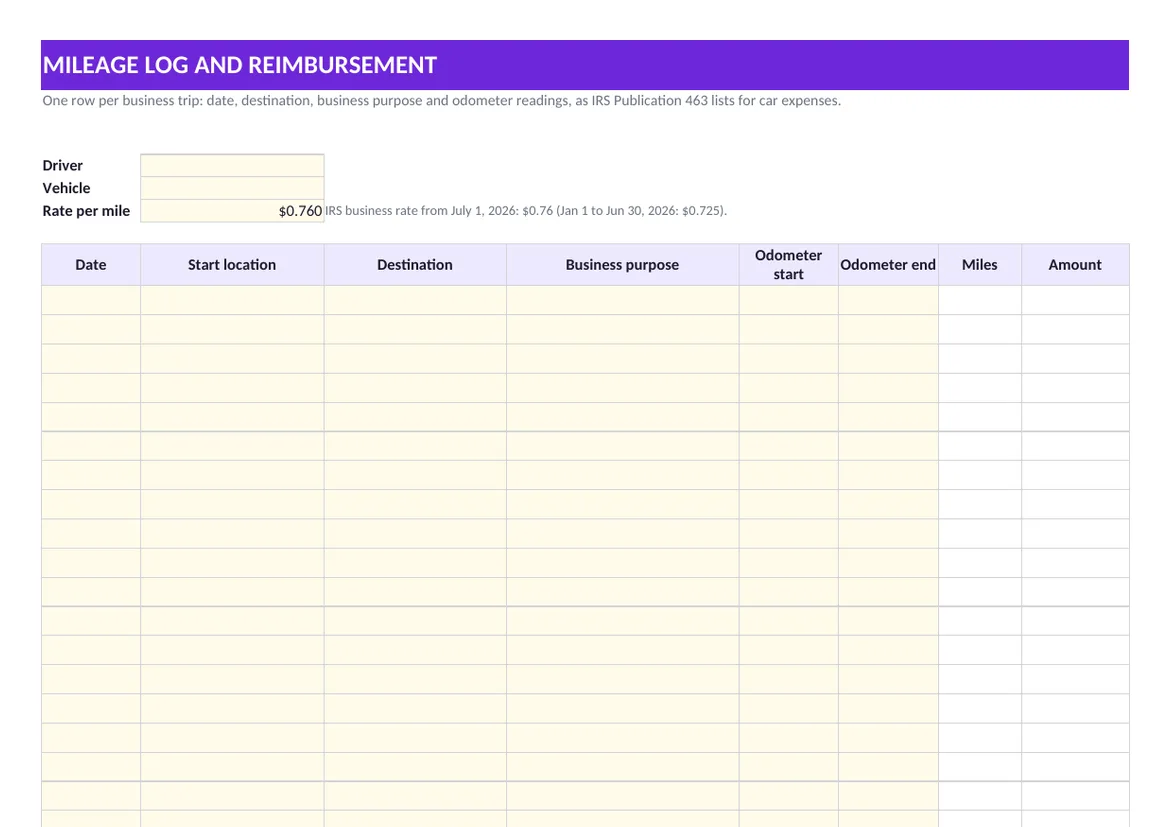
Publication 463 (Table 5-1) lists the records for car expenses: the miles for each business use and the total miles for the year, the date of each trip, the destination and the business purpose. A record made at or near the time of the trip, such as a weekly log, carries more weight than one rebuilt later. Commuting between home and a regular workplace is not business mileage.
| Column in the log | Why it is there |
|---|---|
| Date | The IRS asks for the date of each business use |
| Start and destination | Shows the place the business was done |
| Business purpose | Shows why the trip was business, not commuting |
| Odometer start and end | Gives the miles for each trip |
| Amount | Miles × rate, for reimbursement under an accountable plan |
Worked Example and How to Use the Calculator
A sales representative drives 1,000 business miles in the first half of 2026 and 1,000 in the second. At the IRS rates that is 1,000 × $0.725 = $725.00 plus 1,000 × $0.76 = $760.00, or $1,485.00 for the year. Using 76 cents for all 2,000 miles would give $1,520.00, $35.00 more than the IRS rate supports.
In the calculator, choose the tax year and the purpose, enter the miles before and after July 1, and, if your company pays its own rate, enter it in cents. It shows the amount at IRS rates, each half of the year, and how much of your reimbursement is above the IRS rate. The mileage log download has 20 trip rows with odometer formulas and a rate cell preset to $0.76; change it when the 2027 rate is announced.
Common mistakes
- Using one rate for all of 2026.
- Reimbursing commuting miles as business miles.
- Paying more than the IRS rate without reporting the excess as wages.
- Keeping only a total for the year instead of dated trips with a purpose.
- Assuming the 2027 rate before the IRS announces it.
Trips, Vehicles and Expense Approval in Draivix
Draivix asset management keeps a vehicle logbook that records distance, driver, destination, purpose and cost for each trip, so the log the IRS asks for is filled in as cars are used. Distances in miles and the IRS rate as the reimbursement rate are configured for your company when the system is tailored to you. Approved amounts reach payroll inputs for your payroll provider; for paper receipts, see the expense report template. Draivix does not file taxes or decide what is deductible.
Last reviewed: November 23, 2026. Rates from IRS.gov; this page is general information, not tax advice. Check IRS.gov for the 2027 rate once it is announced.
02Frequently Asked Questions
What is the IRS mileage rate for 2026?
For business driving, 72.5 cents a mile from January 1 to June 30, 2026, and 76 cents a mile from July 1 to December 31, 2026. The IRS raised the rate mid-year in Announcement 2026-11.
What is the IRS mileage rate for 2027?
The IRS had not announced the 2027 rate as of November 23, 2026. Until it does, use the 2026 rates only for miles driven in 2026, and check IRS.gov before the first reimbursement of 2027.
Is mileage reimbursement taxable?
Not when paid under an accountable plan at or below the IRS rate: the employee accounts for the miles and returns any excess. Amounts above the IRS rate, or paid without accounting, are wages in box 1 of Form W-2.
Can an employer reimburse more than the IRS rate?
Yes, but the part above the IRS rate is wages. In the IRS Publication 463 example, 10,000 miles reimbursed at 75 cents in 2025 gives $7,000 at the standard rate under code L in box 12 of Form W-2 and $500 in box 1 as taxable pay.
What should a mileage log include?
IRS Publication 463 lists the date, the destination, the business purpose and the miles of each trip, plus the total miles for the year. Odometer readings at the start and end of each trip are the simplest way to show the miles.
What is the medical and charitable mileage rate?
Medical and military moving miles are 20.5 cents for January to June 2026 and 23.5 cents from July 1, 2026. Charitable miles are 14 cents for all of 2026, the same as in 2023 to 2025.
03More Free Tools
Related Templates & Calculators
- 1099-NEC 2026: $2,000 Threshold, Due February 1, 2027Form 1099-NEC for payments made in 2026: the new $2,000 threshold, who gets one, the February 1, 2027 due date, e-filing at 10 returns, and a vendor tracker.Open
- Minnesota Minimum Wage 2027: $11.87 and OvertimeMinnesota minimum wage is $11.87 from January 1, 2027 for all employers; Minneapolis $17.02. No tip credit, overtime rules, breaks, sick time and final pay.Open
- Tennessee Minimum Wage 2027: $7.25, Breaks, Final PayTennessee has no state minimum wage law, so the federal $7.25 applies in 2027. The 30-minute break rule, final paycheck deadline, paydays and deductions.Open
- South Carolina Minimum Wage 2027: $7.25, Final PaySouth Carolina has no state minimum wage law; the federal $7.25 applies in 2027. Wage notices, 7 days' notice of pay changes, final pay and records.Open
Let’s start together
Tell us how your business works.
We will show you what a system that takes over part of that work could look like.
Book a consultation