
01Free Template · Excel and PDF
Job Application Template: Free Employment Application Form (Excel and PDF)
Free employment application form for employers in Excel and PDF, without the questions the EEOC warns against, plus the I-9, background check and record rules.
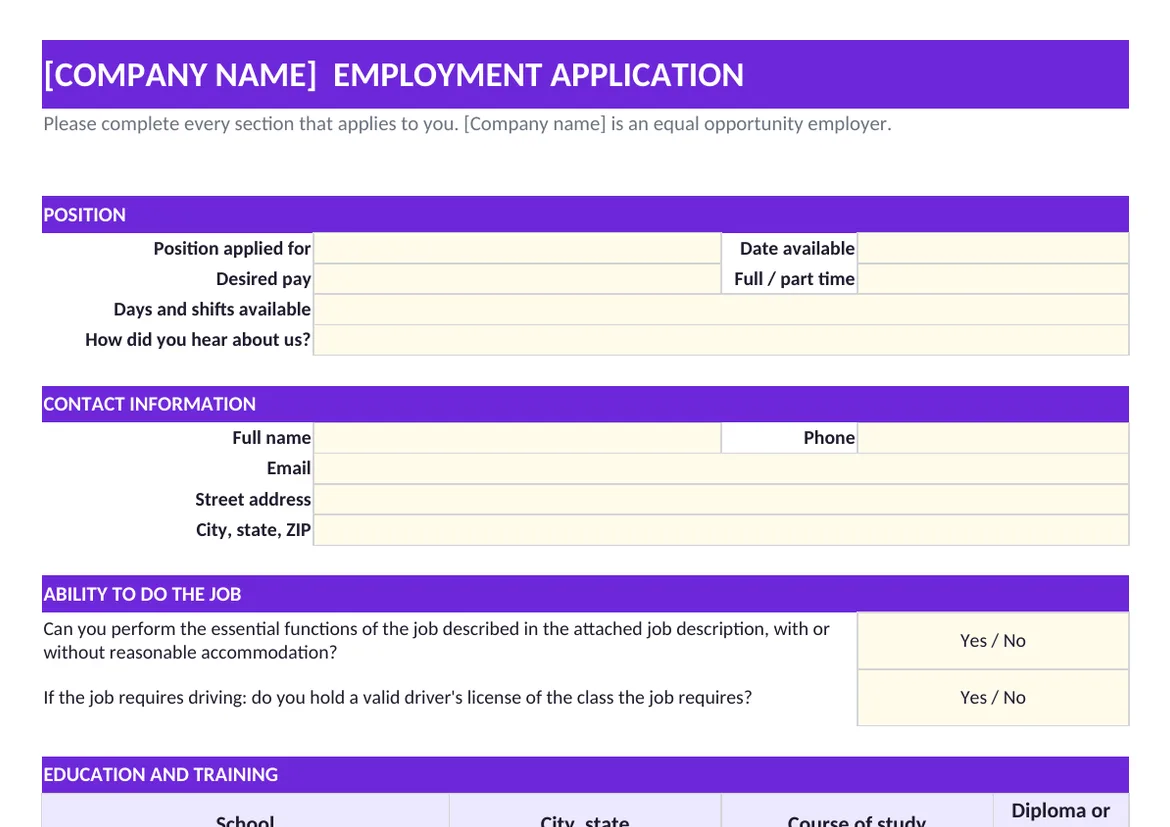
This free job application template is a blank employment application form an employer can hand out or post: position and availability, contact details, education, three previous employers, job-related licenses and skills, references, and a signed certification. Download it in Excel to add your company name and the job, or print the PDF on US Letter paper. The form asks only what helps decide whether the person can do the job.
What it leaves out matters as much. It has no question about disability or health, age or date of birth, race, national origin or citizenship, religion, sex, pregnancy, marital status or children, a photograph, salary history or criminal history, because federal law forbids some of these before a job offer and the EEOC warns that the others can be used as evidence of discrimination. It also does not contain the background check consent: the FCRA requires a separate document for that.
What the Employment Application Asks, and What It Leaves Out
| Topic | On this form | Rule | Source |
|---|---|---|---|
| Disability, health, medical history, workers' compensation history | Not asked. Instead: can you perform the essential functions of the job, with or without reasonable accommodation? | Before an offer, an employer shall not ask whether an applicant has a disability or about its nature or severity; it may ask about the ability to perform job-related functions. The EEOC guidance says workers' compensation history may not be asked either. | 42 U.S.C. § 12112(d)(2), EEOC guidance |
| Race, color, national origin | Not asked | Should not be requested unless there is a legitimate business need, such as affirmative action tracking, and then on a tear-off sheet kept apart from the application. | EEOC |
| Sex, pregnancy, marital status, children, child care | Not asked | Generally viewed as not job-related and problematic under Title VII; may be asked after an offer is made and accepted if needed for insurance or other legitimate purposes. | EEOC, EEOC |
| Religion | Not asked; references from religious leaders not requested | Generally viewed as not job-related, unless religion is a bona fide occupational qualification; religious organizations have an exemption. | EEOC |
| Age, date of birth, graduation years | Not asked | Asking for date of birth or age is not in itself a violation of the ADEA, but such application forms are closely scrutinized; the EEOC lists age among the information that is irrelevant to whether a person is qualified, and such questions may be used as evidence of intent to discriminate. | 29 CFR 1625.5, EEOC |
| Photograph | Not requested | Employers should not ask for a photograph; if needed for identification, it may be obtained after an offer is made and accepted. | EEOC |
| Citizenship | Not asked; the EEOC's suggested statement on work authorization is printed instead | Most employers should not ask whether an applicant is a U.S. citizen before an offer. | EEOC |
| Salary history | Not asked; desired pay instead | Prohibited in some states and cities, for example California and New York (see below). | Cal. Lab. Code § 432.3, N.Y. Lab. Law § 194-a |
| Criminal history | Not asked | Some states and cities forbid the question on the application (ban the box), for example California for employers with 5 or more employees. | Cal. Gov. Code § 12952 |
The EEOC states the limits carefully: federal law does not clearly forbid every question about race, color, sex, national origin, religion or age, but such questions "may be used as evidence of an employer's intent to discriminate unless the questions asked can be justified by some business purpose", and questions that indicate them "should generally be avoided" (EEOC, pre-employment inquiries). Disability is different: the ADA itself prohibits the question before an offer. The federal laws the EEOC enforces cover private employers with 15 or more employees, and 20 or more for age (EEOC coverage); state laws can reach smaller employers, such as California's rule on conviction questions for employers with 5 or more employees.
After the Offer: Form I-9, Medical Exams and Background Checks
Form I-9. Employees "must complete and sign Section 1 of Form I-9 no later than their first day of employment, but may complete Section 1 any time after they accept the job offer" (USCIS), and the employer completes Section 2 within three business days of the hire (8 CFR 274a.2(b)(1)(ii)). So the application does not collect Social Security numbers, passport or green card details. The EEOC suggests telling applicants about it on the application with this sentence, which the template prints: "In compliance with federal law, all persons hired will be required to verify identity and eligibility to work in the United States and to complete the required employment eligibility verification form upon hire" (EEOC).
Medical examinations. After an offer and before work starts, an employer may require a medical examination and condition the offer on it if all entering employees are examined regardless of disability (the EEOC: everyone selected for the same job), and the results are kept in separate, confidential medical files (42 U.S.C. § 12112(d)(3)).
Background checks. To get a consumer report, such as a criminal or driving record from a background check company, the employer must first give a clear and conspicuous written disclosure "in a document that consists solely of the disclosure" and get the applicant's written authorization (15 U.S.C. § 1681b(b)(2)). The FTC puts it plainly: the notice "can't be in an employment application" (FTC). Before rejecting someone because of the report, the employer must give a copy of the report and a written description of the consumer's rights (§ 1681b(b)(3)). The template therefore only says that a separate disclosure will follow.
State Rules: Salary History and Ban the Box
| State | Rule | Who | Source |
|---|---|---|---|
| California | An employer shall not seek salary history information, including compensation and benefits, about an applicant, and shall not rely on it; it may ask about the applicant's salary expectation for the position. Employers with 15 or more employees include the pay scale in job postings. | All employers, including state and local government (§ 432.3(g)) | Cal. Lab. Code § 432.3(a) to (c), (j) |
| California | No question that seeks conviction history on an application, and no inquiry into or consideration of conviction history, until after a conditional offer. | Employers with 5 or more employees; exceptions in subdivision (d), such as positions where a law requires a criminal background check | Cal. Gov. Code § 12952(a), (d) |
| New York | No employer shall rely on wage or salary history in deciding whether to offer employment or the pay, or seek it orally or in writing as a condition to be interviewed, considered or hired; an applicant may disclose it voluntarily. | Employers in the state | N.Y. Lab. Law § 194-a |
This list is not complete. Other states, and many cities and counties, have their own salary history bans and ban-the-box rules, and some apply only to public employers or to employers of a certain size. We list only the rules whose statute we read on November 23, 2026; check your state labor department and your city before you use any application form.
At-Will Statement and How Long to Keep Applications
Many U.S. applications end with an at-will statement next to the signature. The template uses this example wording, which you should have reviewed for your state and your policies: "I understand that, if I am hired, my employment is at will: either the company or I may end it at any time, with or without cause or notice, unless a written agreement signed by an authorized officer of the company says otherwise. This application is not a contract of employment." It is an example, not legal advice: state law and your own handbook or contracts can limit at-will employment.
Keep every application, including those of people you did not hire. The EEOC recordkeeping rule for employers covered by Title VII, the ADA and GINA requires application forms and other hiring records to be preserved "for a period of one year from the date of the making of the record or the personnel action involved, whichever occurs later", and, once a charge of discrimination is filed, all relevant records until the charge or lawsuit is finally resolved (29 CFR 1602.14). Employers covered by the ADEA keep job applications and records of refusals to hire for 1 year from the date of the personnel action (29 CFR 1627.3(b)(1)).
How to Use the Template
Open the Excel file, type your company name in the heading and the position in the first section, and attach a short job description that lists the essential functions, so the question about performing them has a reference. Delete the driver's license question if the job does not involve driving. Print the PDF for walk-in applicants. Collect background check consent later, on its own form, and Form I-9 only after the offer is accepted.
Common mistakes
- Asking "Do you have any disabilities or medical conditions?" before an offer.
- Asking for date of birth or graduation years on the application.
- Printing the background check authorization in the application's fine print.
- Asking for current or past pay where a salary history ban applies; ask for desired pay instead.
- Throwing away applications of rejected candidates before a year has passed.
Applicants and Hiring Stages in Draivix
Draivix Recruitment & Candidate Tracking keeps each applicant as a candidate record with the source of the application, moves candidates through the stages new, screening, interview, offer and hired, or rejected and withdrawn, and lets you add stages such as a reference check. CV parsing fills structured fields and the work history with a confidence score, and every stage change can trigger an automation rule, such as notifying a manager when an offer is made. A hired candidate is not converted into an employee record automatically: you create it, or set up a button or automation rule that does.
Last reviewed: November 23, 2026, against 42 U.S.C. § 12112, 15 U.S.C. § 1681b, 29 CFR 1602.14, 1625.5 and 1627.3, 8 CFR 274a.2, the EEOC, FTC and USCIS pages and the state statutes linked. This page is general information, not legal advice.
Sources and legal basis
- EEOC: prohibited employment policies and practices, pre-employment inquiries (general)
- EEOC: coverage of business and private employers (15 or more employees; 20 or more for age)
- 42 U.S.C. § 12112(d): medical examinations and inquiries (ADA), current through Public Law 119-142
- EEOC Enforcement Guidance: preemployment disability-related questions and medical examinations (October 10, 1995)
- EEOC: pre-employment inquiries and disability
- 29 CFR 1625.5: employment applications, date of birth or age (eCFR)
- EEOC: pre-employment inquiries and citizenship
- EEOC: pre-employment inquiries and gender
- EEOC: pre-employment inquiries and marital status or number of children
- EEOC: pre-employment inquiries and race
- EEOC: pre-employment inquiries and religious affiliation or beliefs
- 15 U.S.C. § 1681b(b): conditions for furnishing and using consumer reports for employment purposes (FCRA)
- FTC: Background Checks: What Employers Need to Know (Wayback capture of November 13, 2026)
- USCIS I-9 Central: completing Section 1, employee information and attestation (last reviewed April 2, 2025; Wayback capture of September 18, 2026)
- 8 CFR 274a.2(b)(1): verification of identity and employment authorization, Form I-9 timing (eCFR)
- 29 CFR 1602.14: preservation of records made or kept (eCFR)
- 29 CFR 1627.3(b)(1): ADEA records relating to personnel actions, job applications kept 1 year (eCFR)
- California Labor Code § 432.3: salary history (Wayback capture of April 7, 2026)
- California Government Code § 12952: conviction history before a conditional offer (Wayback capture of November 16, 2025)
- New York Labor Law § 194-a: wage or salary history inquiries prohibited (Wayback capture of February 26, 2026)
Facts verified:
02Frequently Asked Questions
What questions should not be on a job application?
Questions about disability or health, which the ADA prohibits before an offer, and questions that reveal race, national origin, sex, pregnancy, marital status or children, religion or age, which the EEOC says should generally be avoided. Salary history and criminal history questions are banned in some states and cities.
Can an employer ask for date of birth on a job application?
It is not in itself a violation of the federal age discrimination law, but the EEOC closely scrutinizes application forms that ask for it (29 CFR 1625.5), lists age among the information that is irrelevant to whether a person is qualified and says such questions can be used as evidence of discrimination. Ask after hiring, when payroll and benefits need it.
Can a job application ask about criminal history?
Not everywhere. California, for example, prohibits employers with 5 or more employees from asking about conviction history before a conditional offer (Gov. Code § 12952), with exceptions; other states and cities have similar rules.
Can an employer ask about salary history?
Not in states with a salary history ban, such as California (Lab. Code § 432.3) and New York (Lab. Law § 194-a). California explicitly allows asking about the applicant's salary expectation for the position.
How long do employers have to keep job applications?
One year from the date the record was made or the hiring decision, whichever is later, under 29 CFR 1602.14; longer if a discrimination charge is filed.
When does a new hire fill out Form I-9?
Section 1 after accepting the job offer and no later than the first day of employment, according to USCIS; the employer completes Section 2 within three business days of the hire (8 CFR 274a.2). It is not part of the job application.
03More Free Tools
Related Templates & Calculators
- COGS Calculator: Cost of Goods Sold Formula and FIFO, LIFOCalculate cost of goods sold with the IRS formula, compare FIFO, LIFO and average cost for five purchase lots, and get gross margin. Free Excel with formulas.Open
- Pay Stub Template: Free Excel Earnings StatementFree pay stub template for employers: an Excel earnings statement with gross pay, Social Security, Medicare, deductions, net pay, year-to-date and state rules.Open
- Free Invoice Generator: Online, PDF & Excel TemplateFree invoice generator: fill in the lines online and print or save the invoice as PDF. No sign-up. Plus an Excel invoice template with numbering and sales tax.Open
- Employment Verification Letter: Free Template & SampleEmployment verification letter template for employers: dates, job title, status, and pay only with written consent. Excel and PDF with an authorization form.Open
Let’s start together
Tell us how your business works.
We will show you what a system that takes over part of that work could look like.
Book a consultation